Event submissions
Published
This submission belongs to the session S2. Sustainable Fisheries and Aquaculture Innovations: Combating Overfishing and Advancing Aquatic Health of the event The 1st International Online Conference on Fishes
Published date
03 Nov, 2026
Academic Editor
 Wagner C. Valenti
Citation
Akuita Fernanda Caetana Lima, Fernanda Carlini Cunha dos Santos, Rafael Júnior de Andrade, Karollayne Monik Pacau, Diandra Raila Rocha Miranda, Thaís Milena Marques Couto, Guilherme de Souza Moura, Dietary Tenebrio molitor Larval Meal Enhances Chitinase Activity in Yellowtail Lambari (Astyanax bimaculatus), in Proceedings of The 1st International Online Conference on Fishes, 5 November–6 November 2026, MDPI: Basel, Switzerland
Share
Email
Facebook
Twitter
LinkedIn
Dietary Tenebrio molitor Larval Meal Enhances Chitinase Activity in Yellowtail Lambari (Astyanax bimaculatus)

Akuita Fernanda Caetana Lima 1
Fernanda Carlini Cunha dos Santos 1
Rafael Júnior de Andrade 2
Karollayne Monik Pacau 1
Diandra Raila Rocha Miranda 1
Thaís Milena Marques Couto 1

Guilherme de Souza Moura 3
1. Instituto de Ciências Agrárias, Federal University of Jequitinhonha and Mucuri Valleys (UFVJM), Unaí, Minas Gerais, Brazil
2. Departamento de Bioquímica e Biologia Celular, Federal University of Viçosa – Bioagro, Viçosa, Minas Gerais, Brazil
3. Departamento de Zootecnia, Federal University of Jequitinhonha and Mucuri Valleys (UFVJM), Unaí, Minas Gerais, Brazil
Abstract
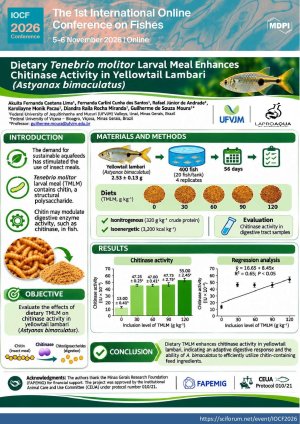
The increasing demand for sustainable aquafeeds has stimulated the evaluation of insect meals as alternative protein sources. Among these, Tenebrio molitor larval meal (TMLM) contains chitin, a structural polysaccharide that may modulate digestive enzyme activity in fish. This study evaluated the effects of dietary TMLM on chitinase activity in yellowtail lambari (Astyanax bimaculatus). A total of 400 fish (2.53 ± 0.13 g) were distributed in a completely randomized design with five dietary treatments and four replicates. Fish were fed isonitrogenous (320 g kg⁻¹ crude protein) and isoenergetic (3,200 kcal kg⁻¹ digestible energy) diets containing 0, 30, 60, 90, or 120 g kg⁻¹ TMLM for 56 days. At the end of the experimental period, chitinase activity was determined in digestive tract samples. Data were subjected to analysis of variance (ANOVA), and significant responses were further evaluated by polynomial regression at a 0.05 significance level. Dietary TMLM significantly affected chitinase activity (P < 0.001). Fish fed the control diet exhibited the lowest activity (13.00 ± 0.41 IU × 10⁻⁴), whereas fish receiving 30, 60, 90, and 120 g kg⁻¹ TMLM showed significantly higher values of 47.25 ± 0.25, 47.00 ± 0.41, 47.75 ± 2.75, and 55.00 ± 2.45 IU × 10⁻⁴, respectively. Regression analysis revealed a positive linear response (ŷ = 16.65 + 8.45x; R² = 0.65; P < 0.05), indicating that increasing dietary inclusion of TMLM progressively enhanced chitinase activity. The elevated enzyme activity suggests an adaptive digestive response to the higher chitin content provided by insect meal, demonstrating the ability of A. bimaculatus to utilize chitin-containing feed ingredients efficiently.
Keywords
aquaculture nutrition
enzyme activity
insect meal
sustainable feed
Poster
Poster chitinase.pdf
First report of food and feeding habits of Gangetic ailia, Ailia coila (Hamilton, 1822) from the Ganga River at Prayagraj, India
Do Opposing Lipid Modulators Shape Gonadal Development in Juvenile Brown Trout?