Event submissions
Published
This submission belongs to the session S1. Climate Change Impact and Marine Pollution of the event The 1st International Online Conference on Fishes
Published date
03 Nov, 2026
Academic Editor
 Pedro Morais
Citation
Davor Merkaš, Martina Ugrinović, Kristina Pikelj, Sara Šariri, Tatjana Mijošek Pavin, Vlatka Filipović Marijićč, Analysis of plastic pollution in water and fish samples from the Adriatic Sea, in Proceedings of The 1st International Online Conference on Fishes, 5 November–6 November 2026, MDPI: Basel, Switzerland
Share
Email
Facebook
Twitter
LinkedIn
Analysis of plastic pollution in water and fish samples from the Adriatic Sea

Davor Merkaš 1
Martina Ugrinović 1
Kristina Pikelj 2
Sara Šariri 1

Tatjana Mijošek Pavin 1

Vlatka Filipović Marijićč 1
1. Division for Marine and Environmental Research
Laboratory for the biological effects of metals
Ruđer Bošković Institute, Bijenička cesta 54, 10000 Zagreb, Croatia
2. University of Zagreb Faculty of Science,
Department of Geology, Zagreb, Croatia
Abstract
Pollution with microplastics (MPs) represents one of the fastest-growing ecological concerns. Due to MPs' wide dispersal, slow degradation, and ability to act as a vector for the intake of other pollutants, they present a threat to the environment, especially to aquatic organisms, leading to ingestion and potential adverse effects at different physiological levels. Another important concern is the lack of standardised methodologies for the isolation and detection of MPs from different tissues, which commonly include chemicals strong enough to digest organic material without damaging the MPs, while also avoiding high temperatures that could alter polymer structures. In the Adriatic Sea (Šibenik Bay), seawater and tissues of wild and farmed gilt-head bream (Sparus aurata) were analysed for the presence of MPs. Several methodologies for digestion of fish intestines and gonads were tested, combining acids, hydroxides, and peroxides at different temperatures in an ultrasonic bath, followed by vacuum filtration over polyester gold-coated filters with a pore size of 0.8 μm. Seawater samples were filtered through sieves of decreasing mesh sizes, collecting four fractions of MPs (1 mm, 500 μm, 125 μm and 63 μm), which were later separated by vacuum filtration. Isolated MPs were analysed optically and by infrared microscopy, using stereo and FT-IR microscopy, where the latter method enables polymer identification. Both samples of seawater and fish tissue showed plastic occurrence, with fibres of different colours being the most common shapes and polystyrene, polyethylene, polypropylene, polyamide, poly(ethylene-co-acrylic acid), and poly(ethylene-co-vinyl acetate) being the common MP types. Generally, MP particles were rare in tissues, depending on the tissue type, with a higher occurrence in fish intestines, confirming dietary uptake as an important exposure route. These findings confirm the presence of MPs in both seawater and marine organisms in the Adriatic Sea, underlining the need for continuous monitoring of MP exposure, accumulation, and potential biological effects.
Keywords
microplastics
seawater
fish
Adriatic Sea
Poster
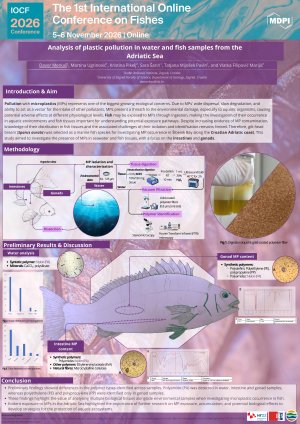
Analysis of plastic pollution in water and fish samples from the Adriatic Sea_DavorMerkaš.pdf
Do Opposing Lipid Modulators Shape Gonadal Development in Juvenile Brown Trout?
Characteristics of the Spawning Environment of Yellowfin Seabream Acanthopagrus latus in Aki-nada, Seto Inland Sea, Japan