Event submissions
Published
This submission belongs to the session S4. Behavioral Ecology of Aquatic Animals: Implications for Habitat Conservation and Ecosystem Services of the event The 1st International Online Conference on Fishes
Published date
03 Nov, 2026
Academic Editor
 Maria Angeles Esteban
Citation
Ririka Sakaguchi, Ryota Uchinotani, Yoshinobu Onishi, Seiei Fujii, Rinko Matsuno, Shinya Nakashita, Tetsuya Umino, Kentaro Kawai, Characteristics of the Spawning Environment of Yellowfin Seabream Acanthopagrus latus in Aki-nada, Seto Inland Sea, Japan, in Proceedings of The 1st International Online Conference on Fishes, 5 November–6 November 2026, MDPI: Basel, Switzerland
Share
Email
Facebook
Twitter
LinkedIn
Characteristics of the Spawning Environment of Yellowfin Seabream Acanthopagrus latus in Aki-nada, Seto Inland Sea, Japan

Ririka Sakaguchi 1
Ryota Uchinotani 1
Yoshinobu Onishi 1
Seiei Fujii 1
Rinko Matsuno 1
Shinya Nakashita 2
Tetsuya Umino 1
Kentaro Kawai 1
1. Graduate School of Integrated Sciences for Life, Hiroshima University, Hiroshima, Japan
2. Department of Civil and Environmental Engineering, National Institute of Technology, Kure College, Kure, Hiroshima, Japan
Abstract
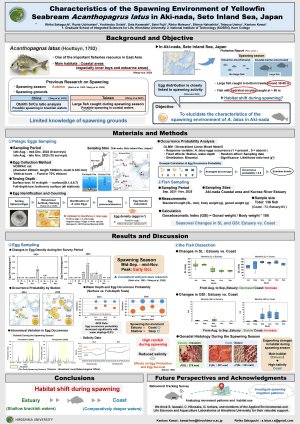
The yellowfin seabream Acanthopagrus latus is an important fisheries resource inhabiting coastal areas, especially estuarine environments throughout eastern Asia. However, its reproductive ecology in natural waters remains poorly understood. This study aimed to characterize the spawning environment of A. latus in Aki-nada, Seto Inland Sea, Japan.
Pelagic eggs were collected by vertical tows using a NORPAC net with a 0.335 mm mesh at 12 sites in Aki-nada from August to December in 2024 and 2025. Spherical eggs were sorted, and those showing a positive reaction in the monoclonal antibody assay were identified as A. latus. Occurrence frequency and density of A. latus eggs were calculated. Fish samples were collected in the Kurose River and Aki-nada by angling and bottom trawling from 2021 to 2025.Standard length (SL), total weight, and gonad weight were measured, and gonadosomatic index (GSI) was calculated from total and gonad weights. The spawning season was estimated from seasonal changes in egg occurrence and GSI. Spawning environments were estimated by egg distribution, together with seasonal patterns in SL and GSI of fish collected from the river and offshore areas.
A. latus eggs were collected from mid-September to mid-November, peaking in early October. Eggs were rarely found around estuarine areas of the Kurose River. In contrast, abundant eggs were observed in offshore areas, particularly in deeper waters. Fish collected in the Kurose River were mainly small and immature individuals with low GSI values during the spawning season, whereas larger mature individuals with high GSI values were consistently collected from deeper waters in Aki-nada. These findings suggest that A. latus may migrate from the Kurose River estuary to deeper areas of Aki-nada for spawning. Interannual variation in egg occurrence was associated with salinity conditions, likely influenced by rainfall, indicating that stable, high-salinity conditions may favor spawning in this species.
Keywords
Diadromous fish
Egg distribution
Estuarine fish
Reproductive strategy
Sparidae
Spawning migration
Poster
Sakaguchi Ririka.pdf
Analysis of plastic pollution in water and fish samples from the Adriatic Sea
Conservation Assessment and Captive Propagation of the Threatened Arabian Bream (Acanthobrama hadiyahensis) in the Khaybar–Northern Hijaz System, Saudi Arabia