Event submissions
Published
This submission belongs to the session S2. Sustainable Fisheries and Aquaculture Innovations: Combating Overfishing and Advancing Aquatic Health of the event The 1st International Online Conference on Fishes
Published date
03 Nov, 2026
Academic Editor
 Wagner C. Valenti
Citation
Ruwanthi Charuka Nanayakkara, S Thivviyan, N Ragavan, Bycatch vulnerability assessment in the Jaffna Lagoon shrimp fyke net fishery using productivity susceptibility analysis, in Proceedings of The 1st International Online Conference on Fishes, 5 November–6 November 2026, MDPI: Basel, Switzerland
Share
Email
Facebook
Twitter
LinkedIn
Bycatch vulnerability assessment in the Jaffna Lagoon shrimp fyke net fishery using productivity susceptibility analysis

Ruwanthi Charuka Nanayakkara 1
S Thivviyan 1
N Ragavan 1
1. Department of Fisheries, Faculty of Science, University of Jaffna, Sri Lanka
Abstract
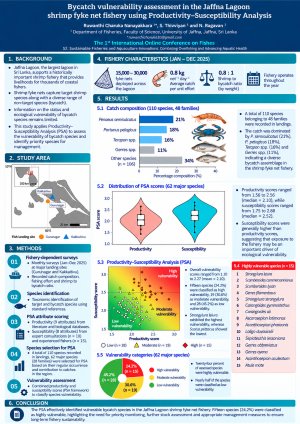
The Jaffna Lagoon, the largest lagoon in Sri Lanka, supports a historically important shrimp fishery that provides livelihoods for thousands of coastal fishers. Although shrimp resources have been previously studied, information on the status and vulnerability of associated bycatch species remains limited. This study applied the Productivity–Susceptibility Analysis (PSA) framework to assess the vulnerability of species captured in the shrimp fyke net fishery and to identify priority species for future stock assessment and management. Monthly fishery surveys (n=12) were conducted from January to December 2025 at the major shrimp landing sites of Jaffna Lagoon. Catch composition, fishing effort, and shrimp to bycatch ratios were recorded. Productivity parameters were compiled from the species-specific literature and biological databases, while susceptibility parameters were derived through expert consultations (n = 10) and focus group discussions with experienced fishers (n = 15). The results indicate that the fishery operated throughout the year, with an estimated 15,000–30,000 fyke nets deployed across the lagoon. The average catch per unit effort was 0.8 kg net⁻¹ day⁻¹, while the shrimp to bycatch ratio was 0.8:1. A total of 110 species belonging to 48 families were recorded in landings, dominated by Penaeus semisulcatus (21% ), Portunus pelagicus (18 %), Terapon spp (16 %), and Gerres spp. (11 %). Of these, 62 major species representing 28 families were selected for PSA assessment. The results indicated that 28 species were classified as low vulnerability, 19 as moderate vulnerability, and 15 as highly vulnerable. Highly vulnerable species included Strongylura leiura, Scomberoides commersonnianus, Scomberoides lysan, Gerres filamentosus, Strongylura strongylura, Carangoides gymnostethus, Carangoides uii, Ascarosepion latimanus, Acanthosepion pharaonis, Loligo duvaucelii, Sepioteuthis lessoniana, Gerres abbreviatus, Gerres oyena, Acanthosepion aculeatum, and Atule mate. This study identifies priority species requiring immediate attention for stock assessment, monitoring, and management to ensure long-term fishery sustainability.
Keywords
Jaffna lagoon
shrimp fishery
fyke net
bycatch
vulnerability assessment
Poster
K.A.D.R.C.Nanayakkara.pdf
Nutritional Composition, Fatty Acid Profile, Mineral Content, and Preliminary Spine Extract Toxicity of the Estuarine Sea Catfish Arius maculatus (Thunberg, 1792) from Panguil Bay, Southern Philippines
Discriminatory Potential of Otolith Contour Morphometry for Population Identification of Semaprochilodus insignis Across Amazonian Rivers