Event submissions
Published
This submission belongs to the session S2. Sustainable Fisheries and Aquaculture Innovations: Combating Overfishing and Advancing Aquatic Health of the event The 1st International Online Conference on Fishes
Published date
03 Nov, 2026
Academic Editor
 Maria Angeles Esteban
Citation
Marcia dos Santos Monteiro, Ellan Rodrigo Monteiro Paes Fernandes, Fernanda Victoria Nery Dias, John Davis, Steven Hall, Adriano Teixeira Oliveira, Optimization of feeding management of juvenile Morone saxatilis in recirculating aquaculture systems for sustainable aquaculture, in Proceedings of The 1st International Online Conference on Fishes, 5 November–6 November 2026, MDPI: Basel, Switzerland
Share
Email
Facebook
Twitter
LinkedIn
Optimization of feeding management of juvenile Morone saxatilis in recirculating aquaculture systems for sustainable aquaculture

Marcia dos Santos Monteiro 1
Ellan Rodrigo Monteiro Paes Fernandes 1
Fernanda Victoria Nery Dias 2
John Davis 3
Steven Hall 4

Adriano Teixeira Oliveira 5
1. Graduate Program in Animal Science and Fisheries Resources, Federal University of Amazonas, Manaus, 69077-00, Brazil
2. Center for Studies on Invertebrates and Vertebrates of the Amazon, Federal Institute of Amazonas, Manaus, 69020-120, Brazil
3. Grinnells Laboratory Applied Ecology, North Carolina State University, Raleigh, 27695, United States of America
4. Department of Biological and Agricultural Engineering , North Carolina State University, Raleigh, 27695, United States of America
5. Academic Department of Basic Education and Teacher Training, Federal Institute of Amazonas, Manaus, 69020-120, Brazil
Abstract
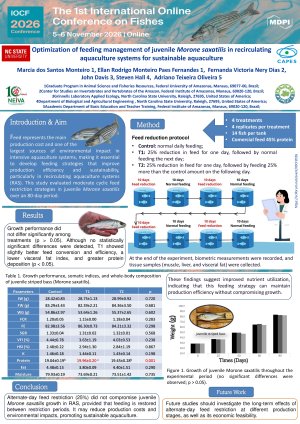
Feed represents the main production cost and one of the largest sources of environmental impact in intensive aquaculture systems, making it essential to develop feeding strategies that improve production efficiency and sustainability, particularly in recirculating aquaculture systems (RASs). This study evaluated moderate cyclic feed restriction strategies in juvenile Morone saxatilis over an 80-day period. A total of 168 fish (28.6 ± 2.9 g) were randomly distributed among 12 tanks and fed a commercial diet containing 45% crude protein. The treatments were divided into three groups: control: normal daily feeding; T1: a 25% reduction in feed for one day, followed by normal feeding the next day; and T2: a 25% reduction in feed for one day, followed by feeding 25% more than the control amount on the following day. The experiment lasted 80 days, during which only the T1 and T2 treatments alternated between 10 days of reduced feeding and 10 days of normal feeding. At the end of the experiment, biometric measurements were recorded, and tissue samples (muscle, liver, and visceral fat) were collected. No significant differences were observed among treatments for final weight, weight gain, or specific growth rate (p > 0.05). Although no statistically significant differences were detected, the T1 group showed slight improvements in feed conversion and feed efficiency, along with a lower visceral fat index. In addition, this group exhibited greater protein deposition (p < 0.05). These findings suggest improved nutrient utilization, indicating that this feeding strategy can maintain production efficiency without compromising growth. It can be concluded that a 25% reduction in feed quantity on alternate days can be adopted without compromising the growth of juvenile Morone saxatilis reared in RAS, provided that feeding is restored between restriction periods. Such strategies may reduce production costs and environmental impacts, contributing to more sustainable aquaculture systems.
Keywords
Aquaculture
RAS system
Juvenile
Striped Bass
Feed Efficiency
Body Composition
Poster
Poster Marcia Monteiro.pdf
Discriminatory Potential of Otolith Contour Morphometry for Population Identification of Semaprochilodus insignis Across Amazonian Rivers
Fulton condition factor K of male endler fish (Poecilia wingei) during their growth