Event submissions
Published
This submission belongs to the session S5. Biodiversity Protection: Conservation of Endangered Species and Control of Invasive Species of the event The 1st International Online Conference on Fishes
Published date
03 Nov, 2026
Academic Editor
 Maria Angeles Esteban
Citation
Marcos Hernández-López, Iran Luna-Vivaldo, Fulton condition factor K of male endler fish (Poecilia wingei) during their growth, in Proceedings of The 1st International Online Conference on Fishes, 5 November–6 November 2026, MDPI: Basel, Switzerland
Share
Email
Facebook
Twitter
LinkedIn
Fulton condition factor K of male endler fish (Poecilia wingei) during their growth

Marcos Hernández-López 1
Iran Luna-Vivaldo 2
1. Political science and public administration, environment and climate change, "El Colegio de Veracruz" University, Xalapa, 91000, Mexico.
2. Postgraduate Department, Doctorate in agricultural sciences program, Faculty of Veterinary Medicine and Zootechnics, Campus Veracruz, University of Veracruz, Veracruz, 91710, México
Abstract
Introduction
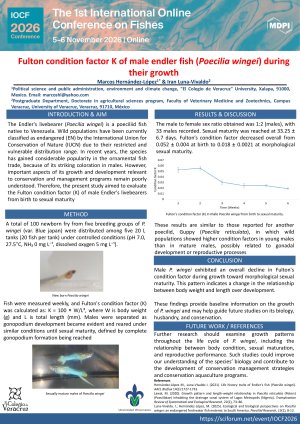
The Endler's livebearer (Poecilia wingei) is a poeciliid fish native to Venezuela whose wild populations are currently classified as endangered (EN) by the International Union for Conservation of Nature (IUCN) due to their restricted and vulnerable distribution range. In recent years, the species has gained considerable popularity in the ornamental fish trade, particularly males, because of its striking coloration. However, important aspects of its growth and development relevant to conservation and management programs remain poorly understood. Therefore, the present study aimed to evaluate the Fulton condition factor (K) of male Endler's livebearers from birth to sexual maturity.
Methods
A total of 100 newborn fry from five breeding groups were distributed among five 20 L tanks (20 fish per tank) under controlled conditions (pH 7.0, 27.5°C, NH₃ 0 mg L⁻¹, dissolved oxygen 5 mg L⁻¹). Weekly biometric measurements were taken, and Fulton’s condition factor was calculated as K = 100 × weight (g)/ total length³ (mm). Males were separated as gonopodium development became evident and reared under similar conditions until sexual maturity, defined by complete gonopodium formation being reached.
Results
The sex ratio obtained was 1:2 (males), with 33 males recorded. Sexual maturity was reached at 33.25 ± 6.7 days. Fulton’s condition factor decreased from 0.052 ± 0.004 at birth to 0.018 ± 0.0021 at sexual maturity.
Conclusions
Male P. wingei showed a decline in Fulton’s condition factor during sexual maturation, indicating that length increased proportionally faster than weight. These findings contribute to the understanding of the species’ biology and provide valuable information for the development of conservation management strategies and conservation aquaculture programs.
Keywords
Conservation
Native species
Aquaculture
ornamental fish
Poster
Fulton K wingei Poster 1IOCF.pdf
Optimization of feeding management of juvenile Morone saxatilis in recirculating aquaculture systems for sustainable aquaculture
EFFECT OF DIETARY INCLUSION OF Vibrio proteolyticus AND Shewanella putrefaciens POSTBIOTICS IN JUVENILE GILTHEAD SEABREAM (Sparus aurata)