Event submissions
Published
This submission belongs to the session S2. Sustainable Fisheries and Aquaculture Innovations: Combating Overfishing and Advancing Aquatic Health of the event The 1st International Online Conference on Fishes
Published date
03 Nov, 2026
Academic Editor
 Wagner C. Valenti
Citation
Vanesa Uribe López, Alba Galafat, Alejandro Morcillo Guillén, Isabel del Carmen Ruiz Rodríguez, Isabel María Cerezo, Jorge García Márquez, Antonio Jesús Vizcaíno, Miguel Ángel Moriñigo, Francisco Javier Alarcón López, EFFECT OF DIETARY INCLUSION OF Vibrio proteolyticus AND Shewanella putrefaciens POSTBIOTICS IN JUVENILE GILTHEAD SEABREAM (Sparus aurata), in Proceedings of The 1st International Online Conference on Fishes, 5 November–6 November 2026, MDPI: Basel, Switzerland
Share
Email
Facebook
Twitter
LinkedIn
EFFECT OF DIETARY INCLUSION OF Vibrio proteolyticus AND Shewanella putrefaciens POSTBIOTICS IN JUVENILE GILTHEAD SEABREAM (Sparus aurata)

Vanesa Uribe López 1
Alba Galafat 1
Alejandro Morcillo Guillén 1
Isabel del Carmen Ruiz Rodríguez 1
Isabel María Cerezo 1
Jorge García Márquez 1
Antonio Jesús Vizcaíno 1
Miguel Ángel Moriñigo 2

Francisco Javier Alarcón López 1
1. Lab 0.24. Department of Biology and Geology, University of Almería, E04120 Almería, Spain
2. Department of Microbiology, University of Málaga, E29071, Málaga, Spain
Abstract
The most effective way to ensure good health in aquaculture species is through the prevention of potential diseases. To this aim, diverse microorganisms have been investigated and applied as probiotics that are capable of improving the immune system of the animals. Furthermore, in recent years, there has been a surge in the use of postbiotic, bioactive compounds of microbial origin that demonstrated great potential for improving fish health. In this context, there is a need to identify and develop novel postbiotics derived from bacterial extracellular products (ECPs).
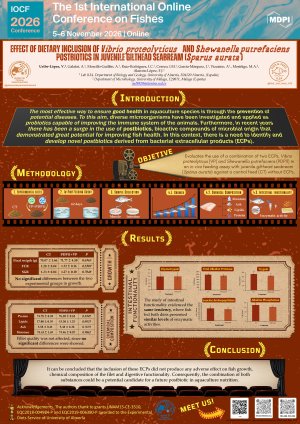
This study evaluates the use of a combination of two ECPs, Vibrio proteolyticus (VP) and Shewanella putrefaciens (PDP11), in an in vivo feeding assay, in which these are included at a low concentration (1010 CFU kg-1) in an experimental diet for juvenile gilthead seabream (Sparus aurata) against a control feed (CT) without ECPs. Growth, chemical composition and intestinal functionality were evaluated. The results showed no significant differences between the two experimental groups in growth and muscle chemical composition. Otherwise, the study of intestinal functionality evidenced the same tendency, where fish fed both diets presented similar levels of enzymatic activities. It can be concluded that the inclusion of these ECPs did not produce any adverse effects on fish growth, chemical composition of the filet and digestive functionality. Consequently, the combination of both substances could be a potential candidate for a future postbiotic in aquaculture nutrition.
Keywords
Aquaculture
digestive functionality
enzymatic activity
gilthead seabream
postbiotic
Poster
Poster_VUL.pdf
Fulton condition factor K of male endler fish (Poecilia wingei) during their growth
Effect of biochar dietary supplementation on digestive function in juvenile turbot