Event submissions
Published
This submission belongs to the session S2. Sustainable Fisheries and Aquaculture Innovations: Combating Overfishing and Advancing Aquatic Health of the event The 1st International Online Conference on Fishes
Published date
03 Nov, 2026
Academic Editor
 Wagner C. Valenti
Citation
Isabel del Carmen Ruiz-Rodríguez, Alba Galafat, Alejandro Morcillo-Guillén, Vanesa Uribe-López, Germán López, Antonio Jesús Vizcaíno, Cristina Rodríguez, Teresa A. Centeno, Alma Hernández de Rojas, Francisco Javier Alarcón-López, Effect of biochar dietary supplementation on digestive function in juvenile turbot, in Proceedings of The 1st International Online Conference on Fishes, 5 November–6 November 2026, MDPI: Basel, Switzerland
Share
Email
Facebook
Twitter
LinkedIn
Effect of biochar dietary supplementation on digestive function in juvenile turbot

Isabel del Carmen Ruiz-Rodríguez 1
Alba Galafat 1
Alejandro Morcillo-Guillén 1
Vanesa Uribe-López 1
Germán López 1
Antonio Jesús Vizcaíno 1
Cristina Rodríguez 2

Teresa A. Centeno 3
Alma Hernández de Rojas 4

Francisco Javier Alarcón-López 1
1. Lab 0.24. Dept. Biology and Geology, University of Almería, 04120 Almería, Spain
2. Spanish Institute of Oceanography, Santander Oceanographic Centre (CN-IEO-CSIC), 39012 Santander, Spain
3. Institute of Carbon Science and Technology (INCAR-CSIC), 33011 Oviedo, Spain
4. Spanish Institute of Oceanography, Gijón Oceanographic Centre (CN-IEO-CSIC), 33212 Gijón, Spain
Abstract
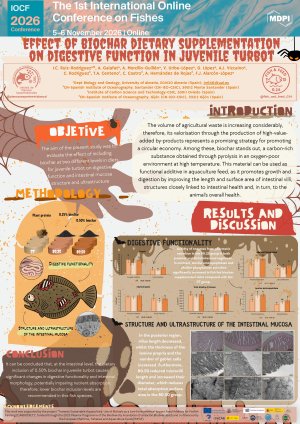
The volume of agricultural waste is increasing considerably; therefore, its valorisation through the production of high-value-added by-products represents a promising strategy for promoting a circular economy. Among these, biochar stands out, a carbon-rich substance obtained through pyrolysis in an oxygen-poor environment at high temperature. This material can be used as a functional additive in aquaculture feed, as it promotes growth and digestion by improving the length and surface area of intestinal villi, structures closely linked to intestinal health and, in turn, to the animal’s overall health. The aim of the present study was to evaluate the effect of including biochar at two different levels in diets for juvenile turbot on digestive function and intestinal mucosa structure and ultrastructure. To this end, three experimental diets were designed: a control diet without biochar (CT), and two diets supplemented with 0.25% (B0.25) and 0.50% (B0.50) biochar. The results showed reduced activity of enzymes from pancreatic secretion in the B0.25 group in both proximal and distal intestinal segments. In contrast, leucine aminopeptidase and alkaline phosphatase activities significantly increased in fish fed biochar-supplemented diets compared with the CT group. Histological analysis revealed changes in the anterior intestine of fish fed 0.50% biochar. In the posterior region, villus length decreased, whilst the thickness of the lamina propria and the number of goblet cells increased. Furthermore, B0.5 reduced microvillus length and increased their diameter, which reduced total absorption surface area in the B0.50 group. Based on the results, it can be concluded that, at the intestinal level, the dietary inclusion of 0.5% biochar in juvenile turbot causes significant changes in digestive functionality and intestinal morphology, potentially impairing nutrient absorption; therefore, lower biochar inclusion levels are recommended in this fish species.
Keywords
Aquaculture
biochar
digestive functionality
intestinal histology
turbot
Poster
iocf2026_ICRR.pdf
EFFECT OF DIETARY INCLUSION OF Vibrio proteolyticus AND Shewanella putrefaciens POSTBIOTICS IN JUVENILE GILTHEAD SEABREAM (Sparus aurata)
In vitro evaluation of algal protein bio-accessibility by digestive proteases from rainbow trout and turbot