Event submissions
Published
This submission belongs to the session S2. Sustainable Fisheries and Aquaculture Innovations: Combating Overfishing and Advancing Aquatic Health of the event The 1st International Online Conference on Fishes
Published date
03 Nov, 2026
Academic Editor
 Wagner C. Valenti
Citation
Alejandro Antonio Morcillo Guillén, Joaquín Martínez Gómez, Isabel del Carmen Ruiz Rodríguez, Vanesa Uribe López, Alba Galafat, Germán López Gálvez, Francisco Javier Alarcón López, Antonio Vizcaíno Torres, In vitro evaluation of algal protein bio-accessibility by digestive proteases from rainbow trout and turbot, in Proceedings of The 1st International Online Conference on Fishes, 5 November–6 November 2026, MDPI: Basel, Switzerland
Share
Email
Facebook
Twitter
LinkedIn
In vitro evaluation of algal protein bio-accessibility by digestive proteases from rainbow trout and turbot

Alejandro Antonio Morcillo Guillén 1
Joaquín Martínez Gómez 1
Isabel del Carmen Ruiz Rodríguez 1
Vanesa Uribe López 1
Alba Galafat 1
Germán López Gálvez 1

Francisco Javier Alarcón López 1
Antonio Vizcaíno Torres 1
1. Laboratory 0.24. Department of Biology and Geology, Higher School of Engineering, University of Almería. La Cañada de San Urbano, 04120 Almeria, Spain.
Abstract
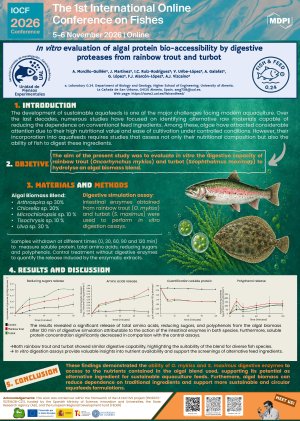
The development of sustainable aquafeeds is one of the major challenges facing modern aquaculture. Over the last decades, numerous studies have focused on identifying alternative raw materials capable of reducing the dependence on conventional feed ingredients. Among these, algae have attracted considerable attention due to their high nutritional value and ease of cultivation under controlled conditions. However, their incorporation into aquafeeds requires studies that assess not only their nutritional composition but also the ability of fish to digest these ingredients.
The aim of the present study was to evaluate in vitro the digestive capacity of rainbow trout (Oncorhynchus mykiss) and turbot (Scophthalmus maximus) to hydrolyse an algal biomass blend composed by Arthrospira sp. (30%), Chlorella sp. (20%), Microchloropsis sp. (10%), Tisochrysis sp. (10%), and Ulva sp. (30%). The mixture contained 43.37 ± 0.71% crude protein and 8.68 ± 0.28% crude lipid content. To this end, a digestive simulation assay was performed using intestinal digestive enzymes obtained from each species. Samples were withdrawn at different times to determine the amount of soluble protein, total amino acids, reducing sugars, and polyphenols released throughout the in vitro simulation assay. In addition, a control treatment without digestive enzymes was included to calculate the release attributable to enzymatic digestion. The results revealed a significant release of total amino acids, reducing sugars, and polyphenols from the algal biomass after 120 min of digestive simulation attributable to the action of the intestinal enzymes in both species. Furthermore, soluble protein concentration significantly decreased in comparison with the control assays. Overall, these findings demonstrated the ability of O. mykiss and S. maximus digestive enzymes to access to the nutrients contained in the algal blend used, supporting its potential as alternative ingredient for sustainable aquaculture feeds.
Keywords
Aquaculture feeds
Digestive simulation
Microalgae
Rainbow trout
Turbot
Poster
Póster IOCF26_AMG.pdf
Effect of biochar dietary supplementation on digestive function in juvenile turbot
Sustainable broodstock nutrition for Megaleporinus obtusidens: effects of Tenebrio molitor larval meal on growth performance