Event submissions
Published
This submission belongs to the session S2. Sustainable Fisheries and Aquaculture Innovations: Combating Overfishing and Advancing Aquatic Health of the event The 1st International Online Conference on Fishes
Published date
03 Nov, 2026
Academic Editor
 Maria Angeles Esteban
Citation
Laura Rosa Correa, Fernanda Carlini Cunha Santos, Karollayne Monik Pacau, Diandra Raila Rocha Miranda, Julimar Santos Sousa, Guilherme Souza Moura, Sustainable broodstock nutrition for Megaleporinus obtusidens: effects of Tenebrio molitor larval meal on growth performance, in Proceedings of The 1st International Online Conference on Fishes, 5 November–6 November 2026, MDPI: Basel, Switzerland
Share
Email
Facebook
Twitter
LinkedIn
Sustainable broodstock nutrition for Megaleporinus obtusidens: effects of Tenebrio molitor larval meal on growth performance

Laura Rosa Correa 1
Fernanda Carlini Cunha Santos 1
Karollayne Monik Pacau 1
Diandra Raila Rocha Miranda 1
Julimar Santos Sousa 2

Guilherme Souza Moura 1
1. Universidade Federal dos Vales do Jequitinhonha e Mucuri (UFVJM), Campus Unaí, Unaí, Minas Gerais, 38610-000, Brazil
2. Companhia de Desenvolvimento dos Vales do São Francisco e do Parnaíba (Codevasf), Três Marias, Minas Gerais, 39205-000, Brazil
Abstract
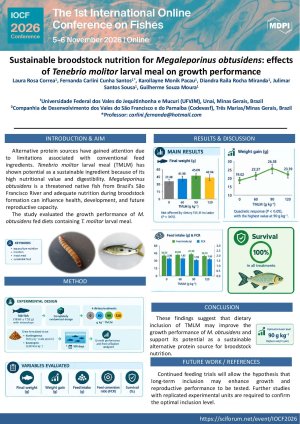
Alternative protein sources have gained attention due to limitations associated with conventional feed ingredients. Tenebrio molitor larval meal (TMLM) has shown potential as a sustainable ingredient because of its high nutritional value and digestibility. Megaleporinus obtusidens is a threatened native fish from Brazil’s São Francisco River and adequate nutrition during broodstock formation can influence health, development, and future reproductive capacity. The study evaluated the growth performance of M. obtusidens-fed diets containing T. molitor larval meal. One hundred microchipped fish (18.63 ± 7.52 g) were distributed in a completely randomized design with four dietary treatments containing 0, 60, 90, and 120 g kg⁻¹ of TMLM for 100 days. Diets were formulated to be isonitrogenous (320 g kg⁻¹ crude protein) and isoenergetic (3,200 kcal kg⁻¹). Final weight, weight gain, and survival were analyzed using ANOVA and regression; feed intake and feed conversion ratio were submitted to descriptive statistics. Fish-fed diets containing 0, 60, 90, and 120 g kg⁻¹ of T. molitor showed final weights of 37.48, 41.00, 45.08, and 42.04 g, weight gains of 19.02, 22.27, 26.38, and 23.39 g, feed intake of 38.50, 40.80, 41.90, and 38.70 g, and feed conversion ratios of 2.00, 1.83, 1.59, and 1.65, respectively. Survival was 100% in all treatments. Final weight was not affected by dietary TMLM inclusion (P > 0.05), whereas weight gain showed a significant quadratic response (P < 0.05), with the highest value observed at 90 g kg⁻¹ of TMLM. These findings suggest that dietary inclusion of TMLM may improve the growth performance of M. obtusidens and support its potential as a sustainable alternative protein source for broodstock nutrition. Continued feeding trials will allow the hypothesis that long-term inclusion may enhance growth and reproductive performance to be tested. Further studies with replicated experimental units are required to confirm the optimal inclusion level.
Keywords
aquaculture nutrition
breeders
insect meal
sustainable feed
Poster
poster.pdf
In vitro evaluation of algal protein bio-accessibility by digestive proteases from rainbow trout and turbot
Development of novel hairpin-mediated isothermal amplification assay for rapid detection of Aeromonas hydrophila in Nile tilapia, Oreochromis niloticus (Linnaeus, 1758)