Event submissions
Published
This submission belongs to the session S2. Sustainable Fisheries and Aquaculture Innovations: Combating Overfishing and Advancing Aquatic Health of the event The 1st International Online Conference on Fishes
Published date
03 Nov, 2026
Academic Editor
 Wagner C. Valenti
Citation
Simon G. Alcantara, Arren Christian de Guia, Gabriel Alexis SP Tubalinal, Anne Franchette Assuncion, Mary Rose Uy-de Guia, Noraine Medina, Claro Mingala, Development of novel hairpin-mediated isothermal amplification assay for rapid detection of Aeromonas hydrophila in Nile tilapia, Oreochromis niloticus (Linnaeus, 1758), in Proceedings of The 1st International Online Conference on Fishes, 5 November–6 November 2026, MDPI: Basel, Switzerland
Share
Email
Facebook
Twitter
LinkedIn
Development of novel hairpin-mediated isothermal amplification assay for rapid detection of Aeromonas hydrophila in Nile tilapia, Oreochromis niloticus (Linnaeus, 1758)

Simon G. Alcantara 1
Arren Christian de Guia 2
Gabriel Alexis SP Tubalinal 2
Anne Franchette Assuncion 3
Mary Rose Uy-de Guia 3

Noraine Medina 4
Claro Mingala 2
1. Institute of Biological Sciences, University of the Philippines Los Baños, Philippines
2. Biosafety and Environment Section, Philippine Carabao Center, Science City of Muñoz, Nueva Ecija, Philippines
3. Production System and Nutrition Section, Philippine Carabao Center, Science City of Muñoz, Nueva Ecija, Philippines
4. College of Veterinary Science and Medicine, Central Luzon State University, Science City of Muñoz, Nueva Ecija, Philippines
Abstract
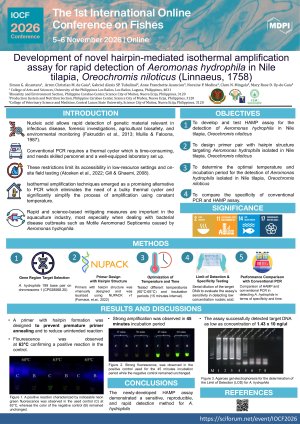
Rapid and field-deployable nucleic acid amplification is essential in pathogen detection. Here, we developed a novel fluorescence-based isothermal amplification assay termed Hairpin-Mediated Isothermal Amplification (HAMP) to detect Aeromonas hydrophila, a zoonotic and motile pathogenic bacterium in Nile tilapia, Oreochromis niloticus. In the Philippines, infection caused by A. hydrophila is a major concern in the tilapia aquaculture industry, as it can cause Motile Aeromonas Septicemia. The newly developed HAMP assay demonstrated a sensitive and fast detection method for this highly virulent bacterium. The method used computationally designed primers with hairpin structures to maintain strong target specificity. The suitable incubation temperature is 63°C and it can detect bacteria within 45 minutes. The assay can detect A. hydrophila DNA with a concentration as low as 1.43x10⁻⁵ ng/µL. When compared side-by-side with the standard polymerase chain reaction assay, the newly optimized fluorescence-based method reduced detection time by 45 minutes. Non-target aeromonads were not amplified in both methods, exemplifying the specificity of the assay while maintaining reliable pathogen detection. Both methods produced clear and specific bands for the positive control, and there were no bands for the negative control. The method requires no specialized equipment beyond a portable heating device, highlighting it as a promising solution for fast, sensitive and accurate nucleic acid detection, particularly useful in resource-limited settings such as fish farms.
Keywords
Fisheries
Primer design
Philippines
Pathogen
Aeromonads
Poster
Alcantara_HAMP.pdf
Sustainable broodstock nutrition for Megaleporinus obtusidens: effects of Tenebrio molitor larval meal on growth performance
Eco-friendly fish farming: Cinnamomum cassia as a natural sustainable growth promoter and health enhancer for rohu (Labeo rohita)