Event submissions
Published
This submission belongs to the session S1. Climate Change Impact and Marine Pollution of the event The 1st International Online Conference on Fishes
Published date
03 Nov, 2026
Academic Editor
 Pedro Morais
Citation
Patricia I. Desa, Melissa I. Ortiz, Félix R. Román, Determination of LC₅₀ of Octinoxate (2-ethylhexyl-4-methoxycinnamate) in Artemia salina, in Proceedings of The 1st International Online Conference on Fishes, 5 November–6 November 2026, MDPI: Basel, Switzerland
Share
Email
Facebook
Twitter
LinkedIn
Determination of LC50 of Octinoxate (2-ethylhexyl-4-methoxycinnamate) in Artemia salina

Patricia I. Desa 1
Melissa I. Ortiz 2
Félix R. Román 2
1. Department of Biology, University of Puerto Rico- Mayagüez Campus, Mayagüez, 00680, Puerto Rico
2. Department of Chemistry, University of Puerto Rico- Mayagüez Campus, Mayagüez, 00680, Puerto Rico
Abstract
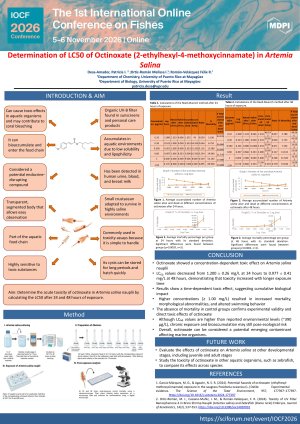
UV filters such as octinoxate have become a growing concern due to their widespread presence and accumulation in aquatic systems. These compounds are frequently detected in water bodies as a result of recreational activities such as swimming and wastewater discharge, with the highest reported concentrations found in coastal seawater, reaching up to 390 µg/L. This study evaluated the toxicity of octinoxate, a component in sunscreens and other personal care products, on Artemia salina at the nauplius stage and calculated LC50 values at 24 and 48 hours of exposure. A stock solution of 200 mg/L octinoxate in methanol was used to prepare six dilutions at concentrations of 0.10, 0.30, 0.50, 0.80, 1.00, and 1.50 mg/L. Four six-well plates were used, with each well containing 10 nauplii. A positive control group containing methanol and artificial seawater as well as a negative one containing only artificial seawater were included for comparison. The treatment groups and controls were analyzed in triplicate. All groups were incubated at 28°C, mortality was recorded using a stereomicroscope and morphological effects were analyzed with a digital microscope at 24 and 48 hours. The results showed a concentration-dependent toxic effect in nauplii. The LC50 was 1.200 ± 0.26 mg/L at 24 hours and 0.977 ± 0.41 mg/L at 48 hours, indicating increased toxicity over time. Additionally, morphological abnormalities and erratic swimming behavior were more frequently observed at higher concentrations (1.00 and 1.50 mg/L). No mortality or visible abnormalities were observed in the negative nor positive control group. These findings emphasize the environmental relevance of octinoxate as a widely used organic UV filter and suggest that its continuous release into aquatic systems may contribute to adverse effects on marine organisms.
Keywords
Octinoxate
Artemia salina
Ecotoxicology
LC50
Poster
poster fishes copia.pdf
Automated Marine Species Classification and Segmentation at Fish Markets Using Convolutional Neural Networks and Transformer Architectures
Tissue-specific oxidative stress responses and trace metal accumulation in farmed and wild mussels from the Adriatic Sea