Event submissions
Published
This submission belongs to the session S1. Climate Change Impact and Marine Pollution of the event The 1st International Online Conference on Fishes
Published date
03 Nov, 2026
Academic Editor
 Pedro Morais
Citation
Tatjana Mijošek Pavin, Davor Merkaš, Zrinka Dragun, Sara Šariri, Damir Valić, Martina Ugrinović, Vlatka Filipović Marijić, Tissue-specific oxidative stress responses and trace metal accumulation in farmed and wild mussels from the Adriatic Sea, in Proceedings of The 1st International Online Conference on Fishes, 5 November–6 November 2026, MDPI: Basel, Switzerland
Share
Email
Facebook
Twitter
LinkedIn
Tissue-specific oxidative stress responses and trace metal accumulation in farmed and wild mussels from the Adriatic Sea

Tatjana Mijošek Pavin 1

Davor Merkaš 1

Zrinka Dragun 1
Sara Šariri 1
Damir Valić 1
Martina Ugrinović 1

Vlatka Filipović Marijić 1
1. Division for Marine and Environmental Research, Ruđer Bošković Institute, 10000 Zagreb, Croatia
Abstract
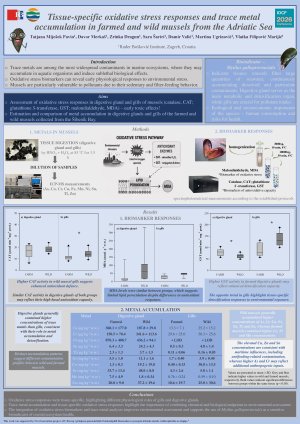
Oxidative stress biomarkers are used to assess sublethal physiological responses of marine organisms to environmental stressors. Mussels (Mytilus galloprovincialis) are suitable bioindicators as sedentary and filter-feeding organisms that have the ability to accumulate contaminants. This study compared tissue-specific oxidative stress responses and trace metal accumulation in farmed and wild mussels from the Šibenik Bay (Middle Adriatic Sea).
Catalase (CAT), glutathione S-transferase (GST) and malondialdehyde (MDA) were analysed spectrophotometrically in gills and digestive glands, while total metal concentrations were determined by ICP-MS.
Digestive glands showed higher CAT activity and MDA concentrations than gills, whereas GST activity was higher in gills. The spatial pattern showed higher CAT activity in wild mussels, especially in gills. GST activity followed the same pattern in gills, whereas in digestive glands, it was higher in farmed mussels. Although MDA concentrations did not differ significantly between mussel groups, their values tended to be higher in wild mussels. Elevated antioxidant enzyme activities in wild mussels may have prevented extensive lipid peroxidation.
Metal analyses also showed distinct accumulation patterns. Digestive glands generally contained higher metal concentrations than gills, confirming their central role in metal accumulation and detoxification. Wild mussels accumulated higher concentrations of Cr, Fe, Cu, Zn, As, Sn, Ba and Tl, whereas farmed mussels were characterised by higher Mn, Co and Ni concentrations. Elevated Cu, Zn and Sn may indicate maritime influences, including antifouling-related contamination, while As and Cr may reflect additional anthropogenic inputs.
Tissue-specific patterns, as well as differences between mussel groups, indicate distinct contamination profiles and physiological responses. Digestive glands function as the primary sites of accumulation and detoxification, whereas gills represent the first line of defence against environmental stressors. Integrating trace metal accumulation and oxidative stress biomarkers improves assessment of contaminant effects and supports the use of M. galloprovincialis as a sensitive bioindicator of coastal ecosystem health.
Keywords
biomarkers
marine pollution
Mytilus galloprovincialis
digestive gland
gills
ICP-MS
Poster
Mijosek_Fishes.pdf
Determination of LC50 of Octinoxate (2-ethylhexyl-4-methoxycinnamate) in Artemia salina
Characteristics of fish community and assessment of fishery resources in the Baise Reservoir, Guangxi, China