Event submissions
Published
This submission belongs to the session S2. Sustainable Fisheries and Aquaculture Innovations: Combating Overfishing and Advancing Aquatic Health of the event The 1st International Online Conference on Fishes
Published date
03 Nov, 2026
Academic Editor
 Wagner C. Valenti
Citation
Yilin zhang, yusen li, wenjian chen, chaojun sui, dapeng wang, feng lin, Characteristics of fish community and assessment of fishery resources in the Baise Reservoir, Guangxi, China, in Proceedings of The 1st International Online Conference on Fishes, 5 November–6 November 2026, MDPI: Basel, Switzerland
Share
Email
Facebook
Twitter
LinkedIn
Characteristics of fish community and assessment of fishery resources in the Baise Reservoir, Guangxi, China

Yilin zhang 1,2,3
yusen li 1,2
wenjian chen 1,2
chaojun sui 1,2,3
dapeng wang 1,2
feng lin 1,2
1. Guangxi Key Laboratory of Aquatic Genetic Breeding and Healthy Aquaculture, Guangxi Academy of Fishery Sciences, Nanning, Guangxi 530021, China
2. Engineering Research Center of Hongshui River Rare Fish Conservation, Guangxi Zhuang Autonomous Region, Nanning, Guangxi 530021, China
3. College of Animal Science and Technology, Guangxi University,Guangxi 530003,China
Abstract
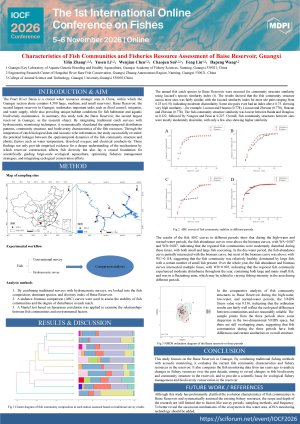
As important artificial freshwater ecosystems, reservoirs host fish communities that are strongly influenced by hydrological regulation and directly respond to fishery cultivation. To investigate the characteristics of fish communities and the fishery resources in the Baise Reservoir, the second largest reservoir in Guangxi, surveys were conducted at ten sampling sites across both the mainstream and tributaries of the Baise Reservoir in July 2024, November 2024, and March 2025. A combination of traditional survey methods and hydroacoustic monitoring technology was employed. A total of 38 fish species were recorded, belonging to 32 genera, 10 families, and 3 orders. Among these, there were 32 native species and 6 invasive alien species, with the number of alien species showing an increasing trend. The dominant species were Parachromis managuensis, Hemiculter leucisculus, Coptodon zillii, Culter alburnus, and Toxabramis houdemeri. Compared with historical data, the fish community structure has undergone significant changes. The Alpha diversity index H′ was 2.17, the richness index D was 3.31, and the evenness index J′ was 0.70. Fish community diversity was similar between the wet season and the normal season, but exhibited certain differences compared with the dry season. Analysis of community structure similarity using Jaccard’s index revealed that most sampling stations had indices between 0.25 and 0.50, indicating moderate dissimilarity. The abundance–biomass comparison (ABC) curve suggested that the fish community was subject to a certain degree of anthropogenic disturbance (overfishing) and remained in a state of ongoing change. Hydroacoustic monitoring results indicated pronounced characteristics of miniaturization, low density, and deep-water aggregation in the fish resources. By integrating traditional catch surveys with hydroacoustic monitoring techniques, this study systematically elucidates the spatiotemporal distribution patterns, community structure, and biodiversity characteristics of fish resources in the Baise Reservoir, providing scientific guidance for large-scale ecological aquaculture and sustainable fishery development.
Keywords
Baise Reservoir
Traditional Fishing
Hydroacoustic Monitoring
Fish
Fishery Resources
Poster
Fishes海报 - 张一林.pdf
Tissue-specific oxidative stress responses and trace metal accumulation in farmed and wild mussels from the Adriatic Sea
Physiological responses of Perccottus glenii to cold stress, freezing, and recovery