Event submissions
Published
This submission belongs to the session S5. Biodiversity Protection: Conservation of Endangered Species and Control of Invasive Species of the event The 1st International Online Conference on Fishes
Published date
03 Nov, 2026
Academic Editor
 Maria Angeles Esteban
Citation
Rui yang Zheng, Feng Lin, Yu sen Li, Jian jun Lei, Jia jie Li, Yi lin Zhang, Chao jun Sui, Da peng Wang, Fish Diversity and Community Composition of the Xijiang River (Wuzhou Section) in Guangxi, China, in Proceedings of The 1st International Online Conference on Fishes, 5 November–6 November 2026, MDPI: Basel, Switzerland
Share
Email
Facebook
Twitter
LinkedIn
Fish Diversity and Community Composition of the Xijiang River (Wuzhou Section) in Guangxi, China

Rui yang Zheng 1,2,3
Feng Lin 1,2
Yu sen Li 1,2
Jian jun Lei 1,2
Jia jie Li 1,2
Yi lin Zhang 1,2,4
Chao jun Sui 1,2,4
Da peng Wang 1,2
1. Guangxi Key Laboratory of Aquatic Genetic Breeding and Healthy Aquaculture, Guangxi Academy of Fishery Sciences, Nanning, Guangxi 530021, China
2. Engineering Research Center of Hongshui River Rare Fish Conservation, Guangxi Zhuang Autonomous Region, Nanning, Guangxi 530021, China
3. School of Enviromental Science and Engineering, Guilin University of Technology, Guilin 541000, China
4. College of Animal Science and Technology, Guangxi University, Guangxi 530003, China
Abstract
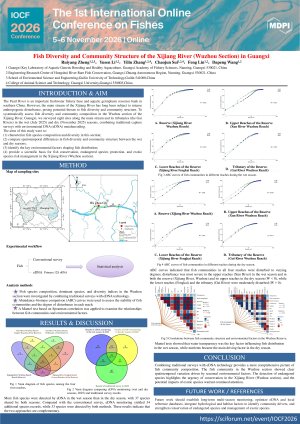
The Pearl River serves as an important freshwater fishery production base and an aquatic germplasm resource bank in southern China. The mainstream of the Xijiang River has long been strongly disturbed by human activities. To investigate fish diversity and community composition in the Wuzhou section of the Xijiang River of Guangxi in China, traditional (market-based) survey methods combined with eDNA technology were applied at eight sampling sites along the main stream and tributaries (Gui River and He River) in July (wet season) and November (dry season) of 2025. Traditional surveys recorded 59 fish species belonging to 9 orders, 21 families, and 48 genera; eDNA surveys detected 67 species belonging to 5 orders and 18 families. Two endangered species, Anguilla japonica (EN) and Cranoglanis bouderius (EN), were found, along with fourteen exotic species. In total, 93 fish species were identified across both methods, but the overlap between eDNA and traditional surveys was only 33 species. Both methods indicated higher fish species richness in the wet season than in the dry season. Cirrhinus molitorella and Megalobrama terminalis were the dominant species. Community stability analysis (ABC curve) showed that the fish community was disturbed, especially in the lower reaches. The diversity index (H′) was 2.64, the richness index (D) was 6.88, and the evenness index (J′) was 0.65. Mantel tests revealed that water transparency was the key factor influencing fish distribution in the wet season, while nutrients became the main driving factor in the dry season. In conclusion, integrating traditional surveys with eDNA technology provides a more comprehensive picture of fish community composition. The fish community structure exhibits clear spatiotemporal differences and seasonally driven environmental characteristics. The discovery of endangered species highlights the necessity of conservation in the Xijiang (Wuzhou section), and the potential impact of exotic species should also be considered. Furthermore, fish resource surveys should integrate traditional methods with environmental DNA approaches to gain a more comprehensive understanding of local fish diversity.
Keywords
Xijiang River
fish community structure
diversity
eDNA
Poster
海报5(1).pdf
Gill histopathological responses of Amphilophus citrinellus larvae subjected to different salinities during larviculture
Environmental Stressors and Gut Microbiome Dysbiosis in Farmed Teleost Fishes: A Systematic Review