Event submissions
Published
This submission belongs to the session S2. Sustainable Fisheries and Aquaculture Innovations: Combating Overfishing and Advancing Aquatic Health of the event The 1st International Online Conference on Fishes
Published date
03 Nov, 2026
Academic Editor
 Maria Angeles Esteban
Citation
Ali Amini Harandi, Mohammad Hossein Pakrooh, Seyed Arman Ahmadi, Environmental Stressors and Gut Microbiome Dysbiosis in Farmed Teleost Fishes: A Systematic Review, in Proceedings of The 1st International Online Conference on Fishes, 5 November–6 November 2026, MDPI: Basel, Switzerland
Share
Email
Facebook
Twitter
LinkedIn
Environmental Stressors and Gut Microbiome Dysbiosis in Farmed Teleost Fishes: A Systematic Review

Ali Amini Harandi 1
Mohammad Hossein Pakrooh 1,2
Seyed Arman Ahmadi 1
1. Faculty of Veterinary Medicine, Shahrekord University, Chaharmahal & Bakhtiari, Iran
2. Institute of Intercontinental Student Veterinary (ISRI-RETM), Technology Development Center, Shahrekord University, Chaharmahal & Bakhtiari, Iran
Abstract
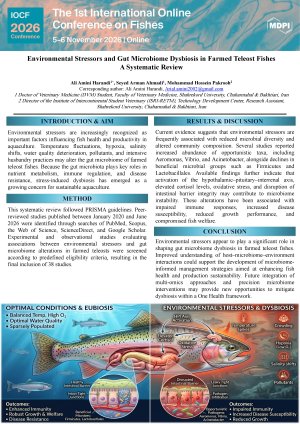
Introduction: Environmental stressors are increasingly recognized as important factors influencing fish health and productivity in aquaculture. Temperature fluctuations, hypoxia, salinity shifts, water quality deterioration, pollutants, and intensive husbandry practices may alter the gut microbiome of farmed teleost fishes. Because the gut microbiota plays key roles in nutrient metabolism, immune regulation, and disease resistance, stress-induced dysbiosis has emerged as a growing concern for sustainable aquaculture.
Methods: This systematic review followed PRISMA guidelines. Peer-reviewed studies published between January 2020 and June 2026 were identified through searches of PubMed, Scopus, the Web of Science, ScienceDirect, and Google Scholar. Experimental and observational studies evaluating associations between environmental stressors and gut microbiome alterations in farmed teleosts were screened according to predefined eligibility criteria, resulting in the final inclusion of 38 studies.
Results: Current evidence suggests that environmental stressors are frequently associated with reduced microbial diversity and altered community composition. Several studies reported increased abundance of opportunistic taxa, including Aeromonas, Vibrio, and Acinetobacter, alongside declines in beneficial microbial groups such as Firmicutes and Lactobacillales. Available findings further indicate that activation of the hypothalamic–pituitary–interrenal axis, elevated cortisol levels, oxidative stress, and disruption of intestinal barrier integrity may contribute to microbiome instability. These alterations have been associated with impaired immune responses, increased disease susceptibility, reduced growth performance, and compromised fish welfare.
Conclusions: Environmental stressors appear to play a significant role in shaping gut microbiome dysbiosis in farmed teleost fishes. Improved understanding of host–microbiome–environment interactions could support the development of microbiome-informed management strategies aimed at enhancing fish health and production sustainability. Future integration of multi-omics approaches and precision microbiome interventions may provide new opportunities to mitigate dysbiosis within a One Health framework.
Keywords
Aquaculture
Gut Microbiome
Dysbiosis
Environmental Stress
Teleost Fish
Poster
Environmental Stressors and Gut Microbiome Dysbiosis in Farmed Teleost Fishes.pdf
Fish Diversity and Community Composition of the Xijiang River (Wuzhou Section) in Guangxi, China
Application of Artificial Intelligence and Machine Learning in Fish Disease Diagnosis: A Systematic Review