Event submissions
Published
This submission belongs to the session S2. Sustainable Fisheries and Aquaculture Innovations: Combating Overfishing and Advancing Aquatic Health of the event The 1st International Online Conference on Fishes
Published date
03 Nov, 2026
Academic Editor
 Maria Angeles Esteban
Citation
Ali Amini Harandi, Gazelle Jacobian, Amin Ahmadi, Application of Artificial Intelligence and Machine Learning in Fish Disease Diagnosis: A Systematic Review, in Proceedings of The 1st International Online Conference on Fishes, 5 November–6 November 2026, MDPI: Basel, Switzerland
Share
Email
Facebook
Twitter
LinkedIn
Application of Artificial Intelligence and Machine Learning in Fish Disease Diagnosis: A Systematic Review

Ali Amini Harandi 1
Gazelle Jacobian 1
Amin Ahmadi 1
1. Faculty of Veterinary Medicine, Shahrekord University, Chaharmahal & Bakhtiari, Iran
Abstract
Abstract
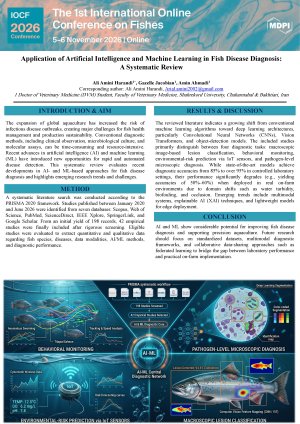
Introduction: The expansion of global aquaculture has increased the risk of infectious disease outbreaks, creating major challenges for fish health management and production sustainability. Conventional diagnostic methods, including clinical observation, microbiological culture, and molecular assays, can be time-consuming and resource-intensive. Recent advances in artificial intelligence (AI) and machine learning (ML) have introduced new opportunities for rapid and automated disease detection. This systematic review evaluates recent developments in AI- and ML-based approaches for fish disease diagnosis and highlights emerging research trends and challenges.
Methods: A systematic literature search was conducted according to the PRISMA 2020 framework. Studies published between January 2020 and June 2026 were identified from seven databases: Scopus, Web of Science, PubMed, ScienceDirect, IEEE Xplore, SpringerLink, and Google Scholar. From an initial yield of 198 records, 42 empirical studies were finally included after rigorous screening. Eligible studies were evaluated to extract quantitative and qualitative data regarding fish species, diseases, data modalities, AI/ML methods, and diagnostic performance.
Results: The reviewed literature indicates a growing shift from conventional machine learning algorithms toward deep learning architectures, particularly Convolutional Neural Networks (CNNs), Vision Transformers, and object-detection models. The included studies primarily distinguish between four diagnostic tasks: macroscopic image-based lesion classification, behavioral monitoring, environmental-risk prediction via IoT sensors, and pathogen-level microscopic diagnosis. While state-of-the-art models achieve diagnostic accuracies from 85% to over 95% in controlled laboratory settings, their performance significantly degrades (e.g., yielding accuracies of 50%–60%) when deployed in real on-farm environments due to domain shifts such as water turbidity, biofouling, and occlusion. Emerging trends include multimodal systems, explainable AI (XAI) techniques, and lightweight models for edge deployment.
Conclusions: AI and ML show considerable potential for improving fish disease diagnosis and supporting precision aquaculture. Future research should focus on standardized datasets, multimodal diagnostic frameworks, and collaborative data-sharing approaches such as federated learning to bridge the gap between laboratory performance and practical on-farm implementation.
Keywords
Artificial Intelligence
Machine Learning
Fish Disease Diagnosis
Precision Aquaculture
Deep Learning
Poster
Application of Artificial Intelligence and Machine Learning in Fish Disease Diagnosis.pdf
Environmental Stressors and Gut Microbiome Dysbiosis in Farmed Teleost Fishes: A Systematic Review
Environmental DNA (eDNA) for Fish Biodiversity Monitoring: A Systematic Review