Event submissions
Published
This submission belongs to the session S1. Climate Change Impact and Marine Pollution of the event The 1st International Online Conference on Fishes
Published date
03 Nov, 2026
Academic Editor
 Pedro Morais
Citation
Ali Amini Harandi, Amin Ahmadi, Alireza Ansari Mahabadi, Microplastics as Drivers of Fish Health Impairment and Disease Susceptibility: A Systematic Review, in Proceedings of The 1st International Online Conference on Fishes, 5 November–6 November 2026, MDPI: Basel, Switzerland
Share
Email
Facebook
Twitter
LinkedIn
Microplastics as Drivers of Fish Health Impairment and Disease Susceptibility: A Systematic Review

Ali Amini Harandi 1
Amin Ahmadi 1
Alireza Ansari Mahabadi 1
1. Faculty of Veterinary Medicine, Shahrekord University, Chaharmahal & Bakhtiari, Iran
Abstract
Abstract
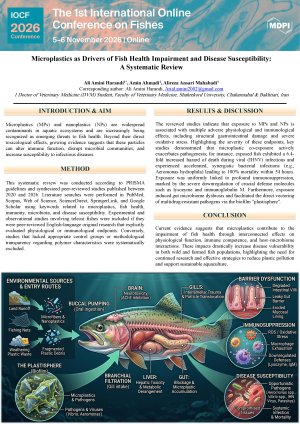
Microplastics (MPs) and nanoplastics (NPs) are widespread contaminants in aquatic ecosystems and are increasingly being recognized as emerging threats to fish health. Beyond their direct toxicological effects, growing evidence suggests that these particles can alter immune function, disrupt microbial communities, and increase susceptibility to infectious diseases.
This systematic review was conducted according to PRISMA guidelines and synthesized peer-reviewed studies published between 2020 and 2026. Literature searches were performed in PubMed, Scopus, Web of Science, ScienceDirect, SpringerLink, and Google Scholar using keywords related to microplastics, fish health, immunity, microbiota, and disease susceptibility. Experimental and observational studies involving teleost fishes were included if they were peer-reviewed English-language original research that explicitly evaluated physiological or immunological endpoints. Conversely, studies that lacked appropriate control groups or methodological transparency regarding polymer characteristics were systematically excluded.
The reviewed studies indicate that exposure to MPs and NPs is associated with multiple adverse physiological and immunological effects, including structural gastrointestinal damage and severe oxidative stress. Highlighting the severity of these endpoints, key studies demonstrated that microplastic co-exposure actively exacerbates pathogenesis; for instance, exposed fish exhibited a 6.4-fold increased hazard of death during viral (IHNV) infections and experienced accelerated, synergistic bacterial infections (e.g., Aeromonas hydrophila) leading to 100% mortality within 54 hours. Exposure was uniformly linked to profound immunosuppression, marked by the severe downregulation of crucial defense molecules such as lysozyme and immunoglobulin M. Furthermore, exposure induced gut microbiome dysbiosis and facilitated the direct vectoring of multidrug-resistant pathogens via the biofilm "plastisphere".
Current evidence suggests that microplastics contribute to the impairment of fish health through interconnected effects on physiological function, immune competence, and host–microbiome interactions. These impacts drastically increase disease vulnerability in both wild and farmed fish populations, highlighting the need for continued research and effective strategies to reduce plastic pollution and support sustainable aquaculture.
Keywords
Microplastics
Fish Health
Disease Susceptibility
Gut Microbiome
Aquaculture
Poster
Microplastics as Drivers of Fish Health Impairment and Disease Susceptibility.pdf
Environmental DNA (eDNA) for Fish Biodiversity Monitoring: A Systematic Review
Efficacy of Phytogenic Compounds and Herbal Extracts on Immune Response in Farmed Fishes: A Systematic Review