Event submissions
Published
This submission belongs to the session S2. Sustainable Fisheries and Aquaculture Innovations: Combating Overfishing and Advancing Aquatic Health of the event The 1st International Online Conference on Fishes
Published date
03 Nov, 2026
Academic Editor
 Maria Angeles Esteban
Citation
Ali Amini Harandi, Alireza Ansari Mahabadi, Amin Ahmadi, Efficacy of Phytogenic Compounds and Herbal Extracts on Immune Response in Farmed Fishes: A Systematic Review, in Proceedings of The 1st International Online Conference on Fishes, 5 November–6 November 2026, MDPI: Basel, Switzerland
Share
Email
Facebook
Twitter
LinkedIn
Efficacy of Phytogenic Compounds and Herbal Extracts on Immune Response in Farmed Fishes: A Systematic Review

Ali Amini Harandi 1
Alireza Ansari Mahabadi 1
Amin Ahmadi 1
1. Faculty of Veterinary Medicine, Shahrekord University, Chaharmahal & Bakhtiari, Iran
Abstract
Abstract
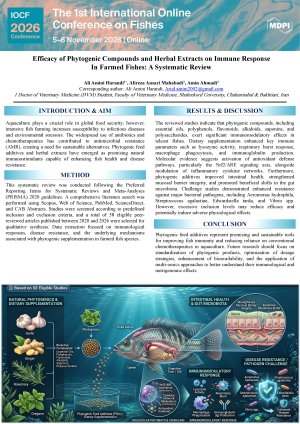
Introduction: Aquaculture plays a crucial role in global food security; however, intensive fish farming increases susceptibility to infectious diseases and environmental stressors. The widespread use of antibiotics and chemotherapeutics has contributed to antimicrobial resistance (AMR), creating a need for sustainable alternatives. Phytogenic feed additives and herbal extracts have emerged as promising natural immunostimulants capable of enhancing fish health and disease resistance.
Methods: This systematic review was conducted following the Preferred Reporting Items for Systematic Reviews and Meta-Analyses (PRISMA) 2020 guidelines. A comprehensive literature search was performed using Scopus, Web of Science, PubMed, ScienceDirect, and CAB Abstracts. Studies were screened according to predefined inclusion and exclusion criteria, and a total of 58 eligible peer-reviewed articles published between 2020 and 2026 were selected for qualitative synthesis. Data extraction focused on immunological responses, disease resistance, and the underlying mechanisms associated with phytogenic supplementation in farmed fish species.
Results: The reviewed studies indicate that phytogenic compounds, including essential oils, polyphenols, flavonoids, alkaloids, saponins, and polysaccharides, exert significant immunomodulatory effects in teleost fishes. Dietary supplementation enhanced key immune parameters such as lysozyme activity, respiratory burst response, macrophage phagocytosis, and immunoglobulin production. Molecular evidence suggests activation of antioxidant defense pathways, particularly the Nrf2/ARE signaling axis, alongside modulation of inflammatory cytokine networks. Furthermore, phytogenic additives improved intestinal health, strengthened mucosal barrier integrity, and promoted beneficial shifts in the gut microbiota. Challenge studies demonstrated enhanced resistance against major bacterial pathogens, including Aeromonas hydrophila, Streptococcus agalactiae, Edwardsiella tarda, and Vibrio spp. However, excessive inclusion levels may reduce efficacy and potentially induce adverse physiological effects.
Conclusions: Phytogenic feed additives represent promising and sustainable tools for improving fish immunity and reducing reliance on conventional chemotherapeutics in aquaculture. Future research should focus on standardization of phytogenic products, optimization of dosage strategies, enhancement of bioavailability, and the application of multi-omics approaches to better understand their immunological and nutrigenomic effects.
Keywords
Phytogenic Feed Additives
Fish Immunity
Aquaculture
Disease Resistance
Herbal Extracts
Poster
Efficacy of Phytogenic Compounds and Herbal Extracts on Immune Response.pdf
Microplastics as Drivers of Fish Health Impairment and Disease Susceptibility: A Systematic Review
Performance of Eucalyptus saligna essential oil growth in diets of Colossoma macropomum juveniles