Event submissions
Published
This submission belongs to the session S2. Sustainable Fisheries and Aquaculture Innovations: Combating Overfishing and Advancing Aquatic Health of the event The 1st International Online Conference on Fishes
Published date
03 Nov, 2026
Academic Editor
 Wagner C. Valenti
Citation
Fabio Aremil Costa dos Santos, Sidney dos Santos Silva, Imaculada de Morais Carvalho Ananias, André de Sena Souza, Narcia Carolina Santos da Silva, Camila Gomes de Oliveira, Paulo Edson Camilo Mol de Oliveira, Luisa Araujo Alves Silva, Gisele Cristina Favero, Sharine Nunes Descovi, Sílvia Mendes da Silva, Bibiana Fontana Batista, Norton Borges Junior, Berta Maria Heinzmann, Bernardo Baldisserotto, Ronald Kennedy Luz, Performance of Eucalyptus saligna essential oil growth in diets of Colossoma macropomum juveniles, in Proceedings of The 1st International Online Conference on Fishes, 5 November–6 November 2026, MDPI: Basel, Switzerland
Share
Email
Facebook
Twitter
LinkedIn
Performance of Eucalyptus saligna essential oil growth in diets of Colossoma macropomum juveniles

Fabio Aremil Costa dos Santos 1
Sidney dos Santos Silva 1
Imaculada de Morais Carvalho Ananias 1
André de Sena Souza 1
Narcia Carolina Santos da Silva 1
Camila Gomes de Oliveira 1
Paulo Edson Camilo Mol de Oliveira 1
Luisa Araujo Alves Silva 1
Gisele Cristina Favero 1
Sharine Nunes Descovi 2
Sílvia Mendes da Silva 2
Bibiana Fontana Batista 3,4
Norton Borges Junior 5
Berta Maria Heinzmann 3,4

Bernardo Baldisserotto 2

Ronald Kennedy Luz 1
1. Aquaculture Laboratory, Department of Animal Science, Federal University of Minas Gerais (UFMG), Belo Horizonte, 31270-901, Brazil
2. Department of Physiology and Pharmacology and Graduate Program in Animal Science, Federal University of Santa Maria, Santa Maria, 97105-900, Brazil
3. Laboratory of Plant Extractives, Department of Industrial Pharmacy and Graduate Program in Forest Engineering, Federal University of Santa Maria, Santa Maria, 97105-900, Brazil
4. Graduate Program in Forest Engineering, Federal University of Santa Maria, Santa Maria, 97105-900, Brazil
5. -, CMPC Celulose Riograndense Ltda, Guaíba, N/A, Brazil
Abstract
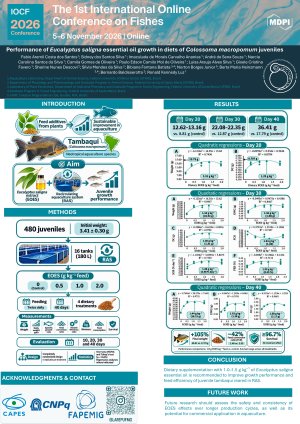
Introduction: Plant-derived feed additives have emerged as sustainable alternatives to improve fish performance in aquaculture. This study evaluated the effects of dietary ethanolic extract of Eucalyptus saligna (EOES) on the growth performance of juvenile tambaqui (Colossoma macropomum) reared in a recirculating aquaculture system (RAS). Methods: A total of 480 juveniles (3.41 ± 0.30 g) were distributed into sixteen 180 -L tanks connected to an RAS. Four diets containing 0.0, 0.5, 1.0, or 2.0 g EOES kg-1 feed were tested in a completely randomized design with four replicates per treatment. Fish were fed twice daily for 40 days. Weight (W), daily weight gain (DWG), specific growth rate (SGR), feed conversion ratio (FCR), protein efficiency ratio (PER), biomass, and survival were evaluated. Results: After 10 days, fish fed 0.5 g kg-1 EOES showed higher W, DWG, SGR, and PER, and lower FCR than the control group (p < 0.05). After 20 days, EOES supplementation increased W (12.62–13.16 vs. 8.81 g), DWG (0.59–0.64 vs. 0.33 g day-1), biomass (1.98–2.06 vs. 1.47 kg m-3), and reduced FCR (1.09–1.18 vs. 1.79). Regression analysis estimated maximum W and feed consumption at 1.31 and 1.23 g EOES kg-1 feed, respectively. After 30 days, fish fed EOES reached 22.08–22.35 g compared with 12.87 g in the control, while optimal inclusion levels ranged from 1.34 to 1.38 g kg-1 feed. After 40 days, final weight reached 36.41 g at 1.0 g kg-1 EOES versus 17.79 g in the control, with maximum W, DWG, and feed consumption estimated at 1.44, 1.63, and 1.68 g EOES kg-1 feed, respectively. Conclusion: EOES improved growth performance and feed efficiency in juvenile tambaqui, with optimal dietary inclusion ranging from 1.3 to 1.7 g kg-1 feed.
Keywords
Sustainable aquafeeds
Phytogenic additive
Recirculating aquaculture system
Fish nutrition
Poster
Poster fabio Aremil_ IOCF 2026.pdf
Efficacy of Phytogenic Compounds and Herbal Extracts on Immune Response in Farmed Fishes: A Systematic Review
Dual Migrations Threaten Local Diversity in the Mediterranean: A Case Study from Syrian Marine Waters