Event submissions
Published
This submission belongs to the session S1. Climate Change Impact and Marine Pollution of the event The 1st International Online Conference on Fishes
Published date
03 Nov, 2026
Academic Editor
 Pedro Morais
Citation
Md Mamunur Rashid, Md. Samsul Kabir, Kanij Rukshana Sumi, Assessment of heavy metal contamination in selected three small indigenous species (SIS) of fish in the coastal region of Bangladesh, in Proceedings of The 1st International Online Conference on Fishes, 5 November–6 November 2026, MDPI: Basel, Switzerland
Share
Email
Facebook
Twitter
LinkedIn
Assessment of heavy metal contamination in selected three small indigenous species (SIS) of fish in the coastal region of Bangladesh

Md Mamunur Rashid 1
Md. Samsul Kabir 1
Kanij Rukshana Sumi 1
1. Department of Aquaculture, Patuakhali Science and Technology University, Dumki, Patuakhali-8660, Bangladesh.
Abstract
Human-driven industrial, agricultural, and mining activities have increased the concentrations of naturally occurring heavy metals in aquatic environments, posing serious risks to water quality and the sustainability of fish stocks. This study investigates heavy metal contamination in three small indigenous fish species, each sampled from a distinct waterbody within Patuakhali district: Esomus danricus from a nearby waterbody in Srirampur, Ailia coila from the Payra River, and Salmostoma bacaila from the Andharmanik River. Species were collected from different sites; findings for each species reflect the combined influence of species-specific bioaccumulation and site-specific environmental conditions, and should not be interpreted as a direct species-to-species comparison. Whole-body concentrations of Cd, Cr, As, Hg, and Pb were measured using Atomic Absorption Spectrophotometry (AAS) on a dry-weight basis. At a particular site, Pb showed the highest mean concentration (mg kg⁻¹), followed by Cd, while Cr and Hg were generally the lowest: at the Srirampur waterbody (Esomus danricus), Pb (2.7017) > Cd (0.6737) > Cr (0.04317) > Hg (0.03275) > As (0.01362); at the Payra River (Ailia coila), Pb (2.8393) > Cd (0.3095) > As (0.12085) > Hg (0.05437) > Cr (0.0347); and at the Andharmanik River (Salmostoma bacaila), Pb (1.7742) > Cd (0.72711) > As (0.08472) > Cr (0.03785) > Hg (0.00987). The Metal Pollution Index (MPI) was highest at the Payra River site (Ailia coila, 0.18), followed by the Srirampur waterbody site (Esomus danricus, 0.13) and the Andharmanik River site (Salmostoma bacaila, 0.12). At all three sites, Pb and Cd exceeded international safety limits, posing potential health risks due to elevated estimated daily intake (EDI) values, particularly for children, while Cr, As, and Hg remained within permissible limits. These findings highlight site-level heavy metal contamination patterns and emphasize the need for improved environmental management and sustainable aquaculture practices. Ongoing monitoring and effective pollution-control strategies are crucial to minimizing bioaccumulation of toxic metals in aquatic ecosystems and protecting public health.
Keywords
Heavy metal
Health risk
Small Indigenous Species (SIS)
Bioaccumulation
Poster
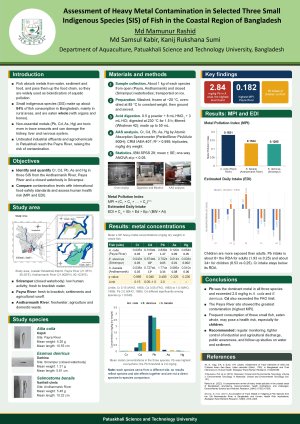
Poster.pdf
Dual Migrations Threaten Local Diversity in the Mediterranean: A Case Study from Syrian Marine Waters
Autochthonous versus allochthonous energy pathways for fish along a gradient of anthropogenic disturbance in tropical rivers