Event submissions
Published
This submission belongs to the session S4. Behavioral Ecology of Aquatic Animals: Implications for Habitat Conservation and Ecosystem Services of the event The 1st International Online Conference on Fishes
Published date
03 Nov, 2026
Academic Editor
 Maria Angeles Esteban
Citation
Matteo Cazzanelli, Manuel Mendoza-Carranza, Maria Mercedes Castillo, Miriam Soria-Barreto, Autochthonous versus allochthonous energy pathways for fish along a gradient of anthropogenic disturbance in tropical rivers, in Proceedings of The 1st International Online Conference on Fishes, 5 November–6 November 2026, MDPI: Basel, Switzerland
Share
Email
Facebook
Twitter
LinkedIn
Autochthonous versus allochthonous energy pathways for fish along a gradient of anthropogenic disturbance in tropical rivers

Matteo Cazzanelli 1
Manuel Mendoza-Carranza 2
Maria Mercedes Castillo 2
Miriam Soria-Barreto 3
1. Department of Biodiversity Conservation, SECIHTI-El Colegio de la Frontera Sur, San Cristóbal de las Casas, Chiapas, Mexico
2. Department of Sustainability Sciences, El Colegio de la Frontera Sur, Villahermosa, Tabasco, Mexico
3. Department of Biodiversity Conservation, El Colegio de la Frontera Sur, San Cristóbal de las Casas, Chiapas, Mexico
Abstract
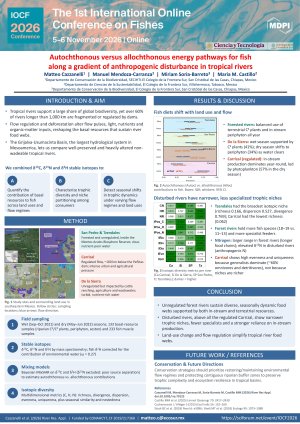
Anthropogenic modifications significantly threaten tropical fluvial ecosystems, yet their combined impacts on food web structures remain poorly understood. This study evaluated how river flow regulation and land use changes alter resource utilization and trophic diversity in tropical fish communities within the Grijalva-Usumacinta Basin in southern Mexico, the largest and most biodiverse river system in Mesoamerica. Fish and basal resources were sampled across two contrasting seasons in four rivers representing distinct levels of disturbance: two forested, unregulated systems (San Pedro and Tzendales), one agricultural, undammed river (De la Sierra), and one flow-regulated river downstream from a hydroelectric dam (Carrizal). Dietary contributions were quantified using stable isotopes of carbon (δ13C), nitrogen (δ15N), and hydrogen (δ2H) integrated with Bayesian mixing models and functional diversity metrics.
The results demonstrated that ecological degradation significantly simplifies food web structure. Fish assemblages in pristine, forested rivers exhibited wide isotopic niche breaths, high trophic divergence, and a balanced reliance on both terrestrial and in-stream organic matter throughout the year. Conversely, anthropogenic impacts caused a marked loss of trophic specialization and reduced niche richness. In the agricultural system, elevated turbidity and runoff suppressed algal production during the wet season, forcing a heavy reliance on allochthonous C3 and C4 plants. In contrast, the dammed river experienced stable, clear flows that promoted persistent, year-round autotrophic pathways, shifting consumer biomass to a narrow dependency on pelagic phytoplankton. Furthermore, fish in both disturbed rivers captured highly enriched nitrogen signals, reflecting substantial uptake of anthropogenic nutrients from wastewater and agricultural runoff. These findings indicate that flow regulation and riparian deforestation drive trophic homogenization and compress food chain length. Conservation priorities should focus on preserving natural flow variability and protecting riparian buffers to maintain complex energy pathways and ecological resilience in tropical river basins.
Keywords
Stable isotope ecology
food web structure
flow regulation
land use changes
Grijalva-Usumacinta Basin
functional diversity
allochthonous carbon
Poster
Poster_Cazzanelli_et_al_IOCF2026.pdf
Assessment of heavy metal contamination in selected three small indigenous species (SIS) of fish in the coastal region of Bangladesh
Automated Feeding in the Production of Brycon amazonicus as a Strategy to Increase Productivity and Feed Efficiency in Amazonian Aquaculture