Event submissions
Published
This submission belongs to the session S2. Sustainable Fisheries and Aquaculture Innovations: Combating Overfishing and Advancing Aquatic Health of the event The 1st International Online Conference on Fishes
Published date
03 Nov, 2026
Academic Editor
 Wagner C. Valenti
Citation
Ellan Rodrigo Monteiro Paes Fernandes, Marcia dos Santos Monteiro, Fernanda Victoria Nery Dias, João Paulo Rufino, Adriano Teixeira Oliveira, Automated Feeding in the Production of Brycon amazonicus as a Strategy to Increase Productivity and Feed Efficiency in Amazonian Aquaculture, in Proceedings of The 1st International Online Conference on Fishes, 5 November–6 November 2026, MDPI: Basel, Switzerland
Share
Email
Facebook
Twitter
LinkedIn
Automated Feeding in the Production of Brycon amazonicus as a Strategy to Increase Productivity and Feed Efficiency in Amazonian Aquaculture

Ellan Rodrigo Monteiro Paes Fernandes 1
Marcia dos Santos Monteiro 1
Fernanda Victoria Nery Dias 2
João Paulo Rufino 1

Adriano Teixeira Oliveira 3
1. Graduate Program in Animal Science and Fishery Resources, Federal University of Amazonas, Manaus, 69077-000, Brazil
2. Center for Studies on Invertebrates and Vertebrates of the Amazon, Federal Institute of Amazonas, Manaus, 69020-120, Brazil
3. Academic Department of Basic Education and Teacher Training, Federal Institute of Amazonas, Manaus, 69020-120, Brazil
Abstract
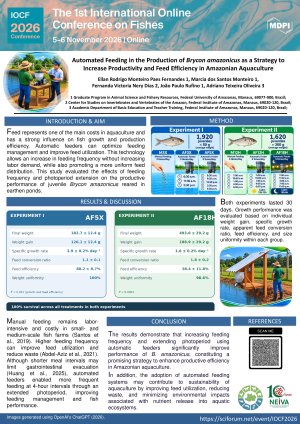
Feed represents one of the main costs in aquaculture and has a strong influence on fish growth and production efficiency. Automatic feeders can optimize feeding management and improve feed utilization. This technology allows an increase in feeding frequency without increasing labor demand, while also promoting a more uniform feed distribution. This study evaluated the effects of feeding frequency and photoperiod extension on the productive performance of juvenile Brycon amazonicus reared in earthen ponds. In Experiment I, 1,920 juveniles with an average weight of ≈50 g were fed manually three times a day (M3X) and with the aid of automatic feeders three times a day (AF3X) and five times a day (AF5X). In Experiment II, 1,620 juveniles with an average weight of ≈300 g were fed manually five times a day under a 12-hour photoperiod (M12H) and under automated feeding systems with 12-hour (AF12H) and 18-hour (AF18H) photoperiods. Both experiments lasted 30 days. In Experiment I, fish from the AF5X treatment showed higher final weight (182.7 g), weight gain (126.1 g), specific growth rate (3.9% day⁻¹), and feed efficiency (88.2%), as well as a lower apparent feed conversion ratio (1.1) compared to other treatments (P < 0.05). A 100% weight uniformity was also observed in this group. In Experiment II, the AF18H treatment resulted in higher final weight (493.6 g), weight gain (188.9 g), SGR (1.6% day⁻¹), and feed efficiency (58.4%), as well as a lower feed conversion ratio (1.8) (P < 0.05). In both experiments, survival rate was 100% across all treatments. The results demonstrate that increasing feeding frequency and extending photoperiod using automatic feeders significantly improve performance of B. amazonicus, constituting a promising strategy to enhance productive efficiency in Amazonian aquaculture. In addition, the adoption of automated feeding systems may contribute to sustainability of aquaculture by improving feed utilization, reducing waste, and minimizing environmental impacts associated with nutrient release into aquatic ecosystems.
Keywords
automated feeding
feeding frequency
photoperiod
feed efficiency
sustainable aquaculture
Poster
Poster Ellan Fernandes.pdf
Autochthonous versus allochthonous energy pathways for fish along a gradient of anthropogenic disturbance in tropical rivers
When the catch label hides the catch: a ddRAD-seq portrait of cryptic Auxis tunas in Indonesian Fisheries Management Area FMA-572