Event submissions
Published
This submission belongs to the session S2. Sustainable Fisheries and Aquaculture Innovations: Combating Overfishing and Advancing Aquatic Health of the event The 1st International Online Conference on Fishes
Published date
03 Nov, 2026
Academic Editor
 Wagner C. Valenti
Citation
Narcia Carolina Santos da Silva, Thamara Bentivole Magalhães, Sidney dos Santos Silva, Isabela Andres Finamor, Bernardo Baldisserotto, Maria Amalia Pavanato, Gisele Cristina Favero, Ronald Kennedy Luz, Oxidative stress biomarkers in juvenile Piaractus brachypomus cultured in RAS and BFT under different crude protein levels, in Proceedings of The 1st International Online Conference on Fishes, 5 November–6 November 2026, MDPI: Basel, Switzerland
Share
Email
Facebook
Twitter
LinkedIn
Oxidative stress biomarkers in juvenile Piaractus brachypomus cultured in RAS and BFT under different crude protein levels

Narcia Carolina Santos da Silva 1
Thamara Bentivole Magalhães 1
Sidney dos Santos Silva 1
Isabela Andres Finamor 2

Bernardo Baldisserotto 2
Maria Amalia Pavanato 2

Gisele Cristina Favero 1

Ronald Kennedy Luz 1
1. Aquaculture Laboratory, Department of Animal Science, School of Veterinary Medicine, Federal University of Minas Gerais (UFMG), Belo Horizonte, Minas Gerais 31270-901, Brazil.
2. Department of Physiology and Pharmacology, Federal University of Santa Maria (UFSM), Santa Maria, Rio Grande do Sul 97105-900, Brazil.
Abstract
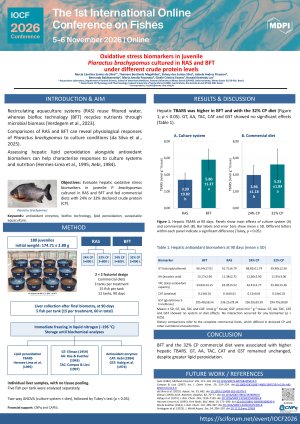
Modern aquaculture requires efficient production systems combined with nutritional strategies capable of reducing costs and environmental impacts. In this context, the present study evaluated the effects of recirculating aquaculture systems (RASs), biofloc technology systems (BFTs), and diets containing 24% or 32% crude protein (CP) on oxidative stress biomarkers in juvenile Piaractus brachypomus. The experiment was conducted using a 2 × 2 factorial design, with two culture systems and two diets, totaling four treatments with three replicates over 90 days. Each experimental unit consisted of 15 fish (174.71 ± 2.80 g) stocked in 800L tanks. At the end of the trial, liver samples from five fish per experimental unit (n = 15) were collected to evaluate hepatic oxidative stress biomarkers, including thiobarbituric acid reactive substances (TBARSs), total glutathione (GT), ascorbic acid (AA), total antioxidant capacity (TAC), catalase (CAT), and glutathione S-transferase (GST). Data were analyzed using two-way ANOVA followed by Tukey’s test (p < 0.05). The results demonstrated a significant effect of culture system on TBARS levels, with higher values observed in fish reared in a BFT (5.80 ± 1.27 nmol g⁻¹) compared to those maintained in an RAS (3.39 ± 0.82 nmol g⁻¹). Likewise, fish fed the 32% CP diet showed higher TBARS concentrations (5.23 ± 1.84 nmol g⁻¹) than those fed the 24% CP diet (3.96 ± 1.18 nmol g⁻¹). However, GT, AA, TAC, CAT, and GST did not differ among treatments (p > 0.05). No interaction was observed between production system and dietary protein level for any analyzed variable (p > 0.05). The results indicate that BFT conditions and higher dietary protein levels may increase susceptibility to lipid peroxidation in P. brachypomus without impairing the evaluated hepatic antioxidant defense mechanisms. Financial support: CNPq and CAPES.
Keywords
antioxidant enzymes
biofloc technology
lipid peroxidation
sustainable aquaculture.
Poster
OXIDATIVE.pdf
When the catch label hides the catch: a ddRAD-seq portrait of cryptic Auxis tunas in Indonesian Fisheries Management Area FMA-572
Hematological and biochemical responses of juvenile Piaractus brachypomus cultured in RAS and BFT under different dietary protein levels