Event submissions
Published
This submission belongs to the session S2. Sustainable Fisheries and Aquaculture Innovations: Combating Overfishing and Advancing Aquatic Health of the event The 1st International Online Conference on Fishes
Published date
03 Nov, 2026
Academic Editor
 Wagner C. Valenti
Citation
Narcia Carolina Santos da Silva, Thamara Bentivole Magalhães, Sidney dos Santos Silva, Rafael José Furtado Sousa, Wagner Junio de Freitas Martins, Cintia Labussière Nakayama, Gisele Cristina Favero, Ronald Kennedy Luz, Hematological and biochemical responses of juvenile Piaractus brachypomus cultured in RAS and BFT under different dietary protein levels, in Proceedings of The 1st International Online Conference on Fishes, 5 November–6 November 2026, MDPI: Basel, Switzerland
Share
Email
Facebook
Twitter
LinkedIn
Hematological and biochemical responses of juvenile Piaractus brachypomus cultured in RAS and BFT under different dietary protein levels

Narcia Carolina Santos da Silva 1
Thamara Bentivole Magalhães 1
Sidney dos Santos Silva 1
Rafael José Furtado Sousa 1
Wagner Junio de Freitas Martins 1
Cintia Labussière Nakayama 1

Gisele Cristina Favero 1

Ronald Kennedy Luz 1
1. Aquaculture Laboratory, Department of Animal Science, School of Veterinary Medicine, Federal University of Minas Gerais (UFMG), Belo Horizonte, Minas Gerais 31270-901, Brazil.
Abstract
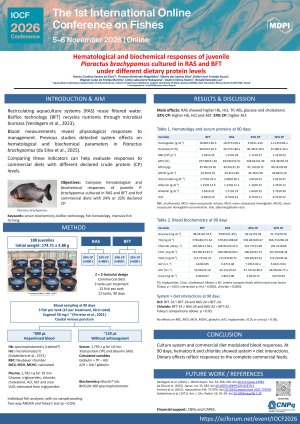
Hematological and biochemical parameters are important physiological indicators of fish health and metabolic responses in intensive aquaculture systems. This study evaluated the hematological and biochemical responses of juvenile Piaractus brachypomus cultured in recirculating aquaculture systems (RASs) and biofloc technology systems (BFTs), and fed diets containing 24% and 32% crude protein (CP). The experiment lasted 90 days and followed a 2 × 2 factorial design with three replicates per treatment. Each experimental unit consisted of 15 fish (174.71 ± 2.80 g) stocked in 800 L tanks. At the end of the experimental period, blood samples were collected from five fish per unit, totaling 15 fish per treatment. Hemoglobin, hematocrit, erythrocytes, MCV, MCH, MCHC, total proteins, albumin, globulin, glucose, triglycerides, chlorides, cholesterol, VLDL, ALT, AST, and urea were evaluated. Data were analyzed using two-way ANOVA followed by Tukey’s test (p < 0.05). An interaction effect was observed for hematocrit and serum chlorides (p < 0.05). Fish reared in RASs showed higher hemoglobin (10.97 g dL⁻¹), hematocrit (32.27%), total proteins (2.98 g dL⁻¹), albumin (1.23 g dL⁻¹), glucose (59.85 mg dL⁻¹), and cholesterol (180.28 mg dL⁻¹) compared to fish cultured in BFTs, which presented lower values for these parameters (p < 0.05). Regarding diets, fish fed 32% CP showed higher hemoglobin (11.12 g dL⁻¹), hematocrit (31.90%), and AST activity (66.96 U L⁻¹), whereas fish fed 24% CP presented higher ALT levels (7.29 U L⁻¹) (p < 0.05). No differences were observed for erythrocytes, triglycerides, globulin, VLDL, or urea between treatments (p > 0.05). The results indicate that both culture system and dietary protein level modulate the physiological responses of P. brachypomus, contributing to the understanding of species adaptation in intensive aquaculture systems. Financial support: CNPq and CAPES.
Keywords
serum biochemistry
biofloc technology
fish hematology
intensive fish farming.
Poster
HEMATOLOGY.pdf
Oxidative stress biomarkers in juvenile Piaractus brachypomus cultured in RAS and BFT under different crude protein levels
Growth performance of juvenile Piaractus brachypomus fed diets containing Hesperozygis ringens essential oil under different thermal conditions