Event submissions
Published
This submission belongs to the session S2. Sustainable Fisheries and Aquaculture Innovations: Combating Overfishing and Advancing Aquatic Health of the event The 1st International Online Conference on Fishes
Published date
03 Nov, 2026
Academic Editor
 Wagner C. Valenti
Citation
Narcia Carolina Santos da Silva, Thamara Bentivole Magalhães, Sidney dos Santos Silva, RAFAEL JOSE FURTADO SOUSA, Wagner Junio de Freitas Martins, Cintia Labussière Nakayama, Gisele Cristina Favero, Ronald Kennedy Luz, Effect of production systems and dietary protein levels on the growth performance of juvenile Piaractus brachypomus, in Proceedings of The 1st International Online Conference on Fishes, 5 November–6 November 2026, MDPI: Basel, Switzerland
Share
Email
Facebook
Twitter
LinkedIn
Effect of production systems and dietary protein levels on the growth performance of juvenile Piaractus brachypomus

Narcia Carolina Santos da Silva 1
Thamara Bentivole Magalhães 1
Sidney dos Santos Silva 1
RAFAEL JOSE FURTADO SOUSA 1
Wagner Junio de Freitas Martins 1
Cintia Labussière Nakayama 1

Gisele Cristina Favero 1

Ronald Kennedy Luz 1
1. Aquaculture Laboratory, Department of Animal Science, School of Veterinary Medicine, Federal University of Minas Gerais (UFMG), Belo Horizonte, Minas Gerais 31270-901, Brazil.
Abstract
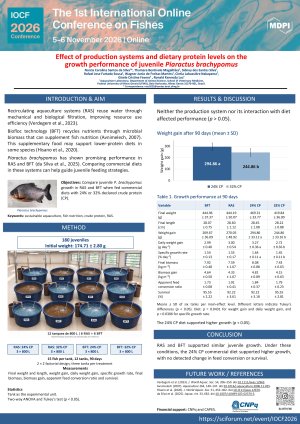
The sustainable intensification of aquaculture requires efficient production systems and cost-effective nutritional strategies. In this context, Piaractus brachypomus stands out due to its rapid growth and adaptability to different farming systems. This study evaluated the zootechnical performance of juvenile P. brachypomus reared in recirculating aquaculture systems (RASs) and biofloc technology systems (BFTs), and fed diets containing 24% and 32% crude protein (CP). The experiment was conducted over 90 days using a 2 × 2 factorial design with three replicates per treatment. Each experimental unit (800 L) contained 15 fish (174.71 ± 2.80 g). The evaluated parameters included final weight, final length, weight gain, daily weight gain, specific growth rate, final biomass, biomass gain, apparent feed conversion ratio, and survival. Data were analyzed using two-way ANOVA followed by Tukey’s test (p < 0.05). No interaction was observed between culture system and dietary protein level for any of the analyzed variables (p > 0.05). The production system did not influence the evaluated zootechnical parameters (p > 0.05), indicating similar fish performance in both RAS and BFT, with final weight close to 445 g, feed conversion ratio ranging from 1.73 to 1.91, and survival rates above 92%. Fish fed the 24% CP diet showed greater weight gain (294.86 g), higher daily weight gain (3.27 g day⁻¹), and higher specific growth rate (1.64% day⁻¹) compared to those fed the 32% CP diet (244.86 g, 2.72 g day⁻¹, and 1.45% day⁻¹, respectively). The results demonstrate the high productive potential of juvenile P. brachypomus in both evaluated systems, indicating the possibility of using diets with lower protein content without impairing growth performance or productive efficiency of the species. Financial support: CNPq and CAPES.
Keywords
sustainable aquaculture
fish nutrition
crude protein
RAS.
Poster
GROWTH.pdf
Growth performance of juvenile Piaractus brachypomus fed diets containing Hesperozygis ringens essential oil under different thermal conditions
Effects of dietary supplementation with Hesperozygis ringens essential oil on hematological and biochemical parameters of juvenile Piaractus brachypomus under different temperature conditions