Event submissions
Published
This submission belongs to the session S2. Sustainable Fisheries and Aquaculture Innovations: Combating Overfishing and Advancing Aquatic Health of the event The 1st International Online Conference on Fishes
Published date
03 Nov, 2026
Academic Editor
 Wagner C. Valenti
Citation
Thamara Bentivole Magalhães, Sidney dos Santos Silva, Imaculada de Morais Carvalho Ananias, Wagner Junio de Freitas Martins, Narcia Carolina Santos da Silva, André de Sena Souza, Fabrio Aremil Costa dos Santos, Bernardo Baldisserotto, Isadora Aguirre Rosa, Berta Maria Heinzmann, Ronald Kennedy Luz, Effects of dietary supplementation with Hesperozygis ringens essential oil on hematological and biochemical parameters of juvenile Piaractus brachypomus under different temperature conditions, in Proceedings of The 1st International Online Conference on Fishes, 5 November–6 November 2026, MDPI: Basel, Switzerland
Share
Email
Facebook
Twitter
LinkedIn
Effects of dietary supplementation with Hesperozygis ringens essential oil on hematological and biochemical parameters of juvenile Piaractus brachypomus under different temperature conditions

Thamara Bentivole Magalhães 1
Sidney dos Santos Silva 1
Imaculada de Morais Carvalho Ananias 1
Wagner Junio de Freitas Martins 1
Narcia Carolina Santos da Silva 1
André de Sena Souza 1
Fabrio Aremil Costa dos Santos 1
Bernardo Baldisserotto 2
Isadora Aguirre Rosa 2
Berta Maria Heinzmann 2

Ronald Kennedy Luz 1
1. Aquaculture Laboratory, Department of Animal Science, School of Veterinary Medicine, Federal University of Minas Gerais (UFMG), Belo Horizonte, Minas Gerais 31270-901, Brazil.
2. Department of Physiology and Pharmacology, Federal University of Santa Maria (UFSM), Santa Maria, Rio Grande do Sul 97105-900, Brazil.
Abstract
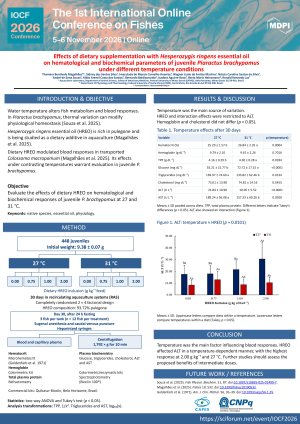
Environmental temperature directly influences fish physiology and may alter hematological and metabolic responses. In aquaculture, phytogenic additives such as essential oils have been investigated as dietary supplements capable of improving physiological stability under stressful conditions. This study evaluated the effects of dietary supplementation with Hesperozygis ringens essential oil (HREO) on the hematological and biochemical parameters of juvenile Piaractus brachypomus reared at different water temperatures. A total of 448 juveniles (9.38 ± 0.07 g) were distributed in recirculating aquaculture systems under a completely randomized 2 × 4 factorial design, consisting of two temperatures (27 and 31 °C) and four dietary HREO inclusion levels (0.00, 0.75, 1.00, and 2.00 g kg⁻¹ feed) for 30 days. At the end of the experimental period, blood samples were collected for hematological and biochemical analyses, including hematocrit, hemoglobin, total plasma protein, glucose, triglycerides, cholesterol, alanine aminotransferase (ALT), and aspartate aminotransferase (AST). The main compound identified in HREO was pulegone (93.72%). Data were analyzed using two-way ANOVA followed by Tukey’s test (p < 0.05). Hematocrit, total plasma protein, and glucose were affected only by temperature, with higher values observed at 31 °C (p < 0.05). Triglycerides and AST levels were higher in fish reared at 27 °C (p < 0.05). Hemoglobin and cholesterol were not influenced by temperature, dietary HREO supplementation, or their interaction (p > 0.05). ALT showed a significant interaction between temperature and HREO inclusion levels, with higher values observed in fish fed 2.00 g kg⁻¹ HREO at 27 °C. Intermediate HREO inclusion levels (0.75 and 1.00 g kg⁻¹) promoted more balanced physiological responses. Water temperature was the main factor influencing hematological and biochemical responses in juvenile P. brachypomus. Dietary HREO supplementation did not negatively affect physiological parameters, and intermediate inclusion levels may contribute to improved metabolic stability under different thermal conditions. Financial support: CAPES and CNPq
Keywords
Native species
essential oil
physiology
Poster
IOCF2026 POSTER THAMARA.pdf
Effect of production systems and dietary protein levels on the growth performance of juvenile Piaractus brachypomus
Regional Modulation of Intestinal Solute Carrier (SLC) Transporters in Rainbow Trout Fed Brewer’s Spent Grain Diets Produced Using Solid-state Fermentation with Pleurotus ostreatus