Event submissions
Published
This submission belongs to the session S4. Behavioral Ecology of Aquatic Animals: Implications for Habitat Conservation and Ecosystem Services of the event The 1st International Online Conference on Fishes
Published date
03 Nov, 2026
Academic Editor
 Maria Angeles Esteban
Citation
Sidi Ahmed Elemin, khadijetou EL Hacen, Mohamed Avoulwatt, A Fish on Local Plates, a Brain Under Stress: Spatial Acetylcholinesterase Inhibition in Clarias gariepinus of the Diawling National Park, Mauritania, in Proceedings of The 1st International Online Conference on Fishes, 5 November–6 November 2026, MDPI: Basel, Switzerland
Share
Email
Facebook
Twitter
LinkedIn
A Fish on Local Plates, a Brain Under Stress: Spatial Acetylcholinesterase Inhibition in Clarias gariepinus of the Diawling National Park, Mauritania

Sidi Ahmed Elemin 1
khadijetou EL Hacen 1
Mohamed Avoulwatt 1
1. Marine Ecology, Environment Nutrition and Health Research Unit (EBIOMESN), Faculty of Sciences and Technology, University of Nouakchott, Nouakchott, N/A, Mauritania
Abstract
Acetylcholinesterase (AChE) is a widely used biomarker in aquatic organisms: it regulates cholinergic neurotransmission, and its activity can be lowered by exposure to anticholinesterase compounds such as organophosphate and carbamate pesticides. In West African coastal systems, the fish most exposed to agricultural and urban runoff are often those that local communities rely on for food, yet the sublethal effects of this exposure remain poorly documented. We measured AChE activity in the African catfish Clarias gariepinus, a species central to local fisheries, sampled at three sites of the Diawling National Park on the right bank of the Senegal River: Lemer, Cheyal, and Bell. Enzyme activity was quantified by kinetic assay at 405 nm. Because the per-individual values were strongly right-skewed and heteroscedastic, sites were compared with a Kruskal–Wallis test followed by Dunn post hoc comparisons (Bonferroni correction). Activity differed significantly among sites (H = 12.9, p = 0.002, ε² = 0.11, a medium effect). Median activity was higher at Lemer (2.30 nmol min⁻¹ mg⁻¹ protein) than at Bell (0.94; p = 0.005) and Cheyal (1.15; p = 0.015), which did not differ from each other; the Lemer–Bell contrast corresponded to a 59% lower median. This pattern held after saturation outliers were removed (p = 0.004). Interpreted cautiously, and without assuming a baseline or reference condition, these relative differences may reflect site-related variation in cholinesterase inhibition, with the lower activities at Bell and Cheyal potentially indicating greater neurotoxic stress. As a low-cost and reproducible biomarker, AChE can help identify sites that warrant further investigation with complementary contaminant and physiological data.
Keywords
behavioural ecology · acetylcholinesterase · Clarias gariepinus · neurotoxicity · biomarkers · Diawling National Park · ecosystem services · Mauritania
Poster
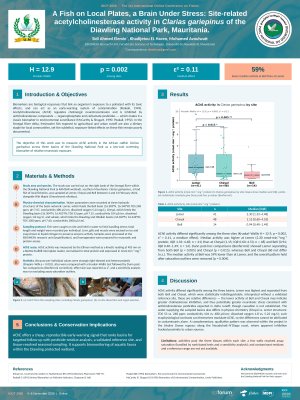
AChE_Diawling_poster_IOCF2026.pdf
Regional Modulation of Intestinal Solute Carrier (SLC) Transporters in Rainbow Trout Fed Brewer’s Spent Grain Diets Produced Using Solid-state Fermentation with Pleurotus ostreatus
Metal bioaccumulation in the freshwater snail Lymnaea stagnalis under the influence of thermal waters in the Mura River side channel