Event submissions
Published
This submission belongs to the session S1. Climate Change Impact and Marine Pollution of the event The 1st International Online Conference on Fishes
Published date
03 Nov, 2026
Academic Editor
 Pedro Morais
Citation
Zoran Kiralj, Nausicaa Falconnat, Tatjana Mijošek Pavin, Dušica Ivanković, Lore Graulus, Jasna Lajtner, Krešimir Žganec, Zrinka Dragun, Metal bioaccumulation in the freshwater snail Lymnaea stagnalis under the influence of thermal waters in the Mura River side channel, in Proceedings of The 1st International Online Conference on Fishes, 5 November–6 November 2026, MDPI: Basel, Switzerland
Share
Email
Facebook
Twitter
LinkedIn
Metal bioaccumulation in the freshwater snail Lymnaea stagnalis under the influence of thermal waters in the Mura River side channel

Zoran Kiralj 1
Nausicaa Falconnat 2

Tatjana Mijošek Pavin 1
Dušica Ivanković 1
Lore Graulus 3
Jasna Lajtner 4
Krešimir Žganec 5

Zrinka Dragun 1
1. Ruđer Bošković Institute, Zagreb, Croatia
2. School for Biology-Biochemistry-Biotechnologies, Lyon Catholic University, Lyon, France
3. HOGENT University of Applied Sciences and Arts, Health Care Department, Biomedical Laboratory Technology, Genth,Belgium
4. Department of Biology, Faculty of Science, University of Zagreb, Zagreb, Croatia
5. Department of Teacher Education Studies in Gospić, University of Zadar, Zadar, Croatia
Abstract
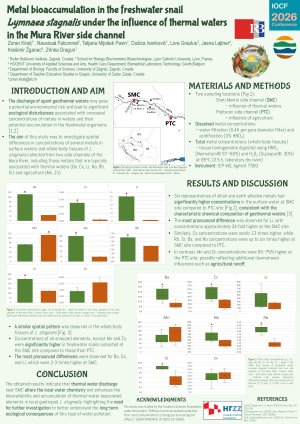
The discharge of spent geothermal waters may pose a potential environmental risk and lead to significant ecological disturbances associated with increased concentrations of metals and their potential accumulation in the freshwater organisms [1,2]. The aim of this study was to investigate spatial differences in metal concentrations (Ba, Cs, Li, Mn, Na, Rb, Sr, and Zn) in surface water and whole-body tissues of L. stagnalis collected from two branches of the Mura River. The first site was located near Sveti Martin na Muri (SM), potentially influenced by thermal water discharge from thermal resort Sveti Martin, while the second site was near Podturen (PT), approximately 20 km downstream. Almost all measured elements were present at higher concentrations in the surface water at SM site compared to PT site. The most pronounced difference was observed for Li, which concentrations were approximately 24-fold higher at the SM site. Similarly, Cs concentrations were nearly 13 times higher, while Rb, Sr, Ba, and Na concentrations were up to six times higher at SM site compared to PT. Such elevated concentrations of alkali and alkaline earth metals are consistent with the characteristic chemical composition of geothermal waters [3]. In contrast, Mn and Zn concentrations were 55–75% higher at the PT site, possibly reflecting additional downstream influences such as agricultural runoff. A similar spatial pattern was observed in the whole-body tissues of L. stagnalis. Concentrations of all analyzed elements, except Mn and Zn, were up to 3 times higher in snails collected at the SM site compared to those from PT. The obtained results indicate that thermal water discharge near SM alters the local water chemistry and enhances the bioavailability and accumulation of thermal-water associated elements in L. stagnalis, highlighting the need for further monitoring to better understand the long-term ecological consequences of this type of water pollution.
Keywords
thermal water
freshwater snail
metal concentrations
Mura
Poster
ZKiralj_Fishes_POSTER.pdf
A Fish on Local Plates, a Brain Under Stress: Spatial Acetylcholinesterase Inhibition in Clarias gariepinus of the Diawling National Park, Mauritania
Characterization and Economic Feasibility of Fish Farming in the Metropolitan Region of Manaus, Brazil