Event submissions
Published
This submission belongs to the session S2. Sustainable Fisheries and Aquaculture Innovations: Combating Overfishing and Advancing Aquatic Health of the event The 1st International Online Conference on Fishes
Published date
03 Nov, 2026
Academic Editor
 Wagner C. Valenti
Citation
Carlos André Silva Lima, Anderson Barroso Maquiné, Paulo Victor Oliveira Neles, Francinete Tobar Bernardo, Rômulo Ferreira dos Santos, Karla Garcia Vasconcelos, Walter Nobre da Silva Conceição, João Victor Silva de Souza, João Marcos Miranda Nogueira, Daniel José De Lima Prestes, Marcelo Lima de Barros, Francielma Simões Vargas, Kedma Cristine Yamamoto, Characterization and Economic Feasibility of Fish Farming in the Metropolitan Region of Manaus, Brazil, in Proceedings of The 1st International Online Conference on Fishes, 5 November–6 November 2026, MDPI: Basel, Switzerland
Share
Email
Facebook
Twitter
LinkedIn
Characterization and Economic Feasibility of Fish Farming in the Metropolitan Region of Manaus, Brazil

Carlos André Silva Lima 1
Anderson Barroso Maquiné 2
Paulo Victor Oliveira Neles 2
Francinete Tobar Bernardo 2
Rômulo Ferreira dos Santos 2
Karla Garcia Vasconcelos 2
Walter Nobre da Silva Conceição 2
João Victor Silva de Souza 2
João Marcos Miranda Nogueira 2
Daniel José De Lima Prestes 2
Marcelo Lima de Barros 2
Francielma Simões Vargas 2
Kedma Cristine Yamamoto 3
1. Environmental Analyst, Amazonas State Institute for Environmental Protection (IPAAM), Manaus, Amazonas, Brazil
2. Faculty of Agricultural Sciences, Federal University of Amazonas (UFAM), Manaus, Amazonas, Brazil
3. Department of Fisheries Sciences (DEPESCA), Faculty of Agricultural Sciences, Federal University of Amazonas (UFAM), Manaus, Amazonas, Brazil
Abstract
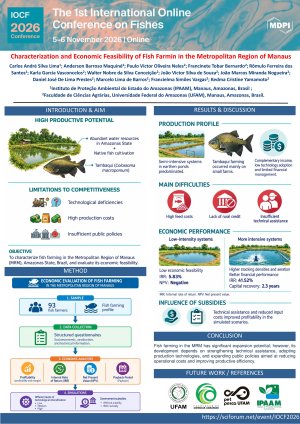
Introduction: Fish farming in the Amazonas state has high productive potential due to the abundance of water resources and the cultivation of native species, especially tambaqui (Colossoma macropomum). However, the activity still presents low competitiveness, limited by technological deficiencies, high production costs, and insufficient public policies. This study aimed to characterize the fish farming profile in the Metropolitan Region of Manaus (MRM), Amazonas State, Brazil, and evaluate its economic feasibility. Methods: A total of 93 fish farmers from the MRM were interviewed using structured questionnaires containing socioeconomic, productive, and technical information. Economic analyses were performed using profitability indicators, Internal Rate of Return (IRR), Net Present Value (NPV), and Payback Period (PP). Simulations were also conducted considering different levels of technological intensification and government subsidies. Results: Semi-intensive systems in earthen ponds predominated, with tambaqui production occurring mainly in small-scale farms. Fish farming was characterized as a complementary income activity, with low technological adoption and limited financial management. The main difficulties reported were high feed costs, lack of rural credit, and insufficient technical assistance. Low-intensity production systems showed poor economic feasibility, with an IRR of 5.83% and negative NPV. In contrast, more intensive systems, with higher stocking densities and aeration use, showed better financial performance, reaching an IRR of 41.52% and capital recovery within 2.3 years. Subsidies related to technical assistance and reduced input costs positively influenced profitability. Conclusions: Fish farming in the MRM has significant expansion potential; however, its development depends on strengthening technical assistance, adopting production technologies, and expanding public policies aimed at reducing operational costs and improving productive efficiency.
Keywords
Colossoma macropomum
Aquaculture
Sustainability
Economic indicators.
Poster
Poster_Cientifico_IOCF2026.pdf
Metal bioaccumulation in the freshwater snail Lymnaea stagnalis under the influence of thermal waters in the Mura River side channel
Feed Restriction in Juvenile Piaractus brachypomus Under BFT