Event submissions
Published
This submission belongs to the session S2. Sustainable Fisheries and Aquaculture Innovations: Combating Overfishing and Advancing Aquatic Health of the event The 1st International Online Conference on Fishes
Published date
03 Nov, 2026
Academic Editor
 Wagner C. Valenti
Citation
Cristiano Campos Mattioli, João Victor da Silva, Luiz Felipe da Silveira Silva, Tiago Correa Krauzer, Gisele Cristina Favero, Ronald Kennedy Luz, Cintia Labussière Nakayama, Feed Restriction in Juvenile Piaractus brachypomus Under BFT, in Proceedings of The 1st International Online Conference on Fishes, 5 November–6 November 2026, MDPI: Basel, Switzerland
Share
Email
Facebook
Twitter
LinkedIn
Feed Restriction in Juvenile Piaractus brachypomus Under BFT

Cristiano Campos Mattioli 1

João Victor da Silva 1
Luiz Felipe da Silveira Silva 1
Tiago Correa Krauzer 1

Gisele Cristina Favero 1

Ronald Kennedy Luz 1
Cintia Labussière Nakayama 1
1. Aquaculture Laboratory, Department of Animal Science, Federal University of Minas Gerais, 6627 Antônio Carlos Avenue, Zip Code: 30161-970, Belo Horizonte, Minas Gerais, Brazil
Abstract
Optimizing feeding management is crucial for the economic sustainability of intensive aquaculture. This study evaluated the effects of cyclic feed restriction on the zootechnical performance, physiological responses, and feed costs of juvenile Piaractus brachypomus reared in a biofloc technology (BFT) system. Two hundred and twenty-five juveniles (1.75 ± 0.41 g) were subjected to three feeding regimes for 56 days: daily feeding (T7, control), restriction of one day per week (T6), and restriction of two consecutive days per week (T5). Water quality parameters remained stable and within suitable ranges across all treatments. Although final weight, total length, and biomass were higher (p < 0.05) in T7 compared to T5, there were no differences (p > 0.05) in specific growth rate, feed conversion ratio, or productivity among the treatments. A dose-dependent increase in plasma glucose and triglycerides was observed with T7 (p < 0.05). Survival was lower (p < 0.05) in T5 (86.67%) compared to T7 (100%). Feed cost analysis showed a reduction of 29% for T5 and 9% for T6 relative to T7. The study concludes that the one-day-per-week restriction regimen (T6) represents an optimal adjustment, reducing feed costs by approximately 9% without significantly compromising growth performance, feed efficiency, or survival of P. brachypomus in a BFT system. This strategy balances economic savings with the maintenance of key productive indicators. Financial support: CNPQ, and CAPES.
Keywords
Intermittent feeding
Nutritional programming
Blood metabolites
Economic feasibility
Sustainable intensive aquaculture
Poster
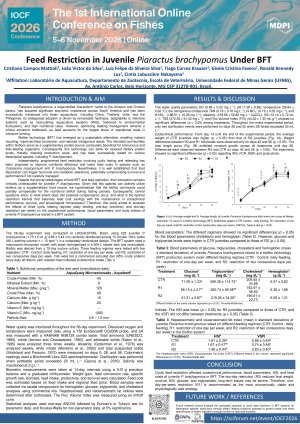
Cristiano Mattioli baner IOCF 2026.pdf
Characterization and Economic Feasibility of Fish Farming in the Metropolitan Region of Manaus, Brazil
The changes in blood metabolic biomarkers in two fishes, Squalius cephalus and Barbus barbus, in association with diffuse pollution of the Mura River (Croatia)