Event submissions
Published
This submission belongs to the session S1. Climate Change Impact and Marine Pollution of the event The 1st International Online Conference on Fishes
Published date
03 Nov, 2026
Academic Editor
 Pedro Morais
Citation
Zrinka Dragun, Josip Barišić, Damir Valić, Zoran Kiralj, Katerina Rebok, Milica Ristovska, The changes in blood metabolic biomarkers in two fishes, Squalius cephalus and Barbus barbus, in association with diffuse pollution of the Mura River (Croatia), in Proceedings of The 1st International Online Conference on Fishes, 5 November–6 November 2026, MDPI: Basel, Switzerland
Share
Email
Facebook
Twitter
LinkedIn
The changes in blood metabolic biomarkers in two fishes, Squalius cephalus and Barbus barbus, in association with diffuse pollution of the Mura River (Croatia)

Zrinka Dragun 1

Josip Barišić 2
Damir Valić 1
Zoran Kiralj 1
Katerina Rebok 3
Milica Ristovska 3
1. Ruđer Bošković Institute, Division for Marine and Environmental Research, Zagreb, Croatia
2. MSD Animal Health Innovation AS, Bergen, Norway
3. Faculty of Natural Sciences and Mathematics, University Ss. Cyril and Methodius in Skopje, Skopje, North Macedonia
Abstract
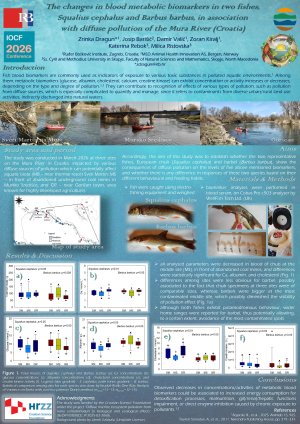
Fish blood biomarkers are commonly used as indicators of exposure to various toxic substances in polluted aquatic environments. Among them, metabolic biomarkers (glucose, albumin, cholesterol, calcium, creatine kinase) can exhibit concentration/activity increases or decreases, depending on the type and degree of pollution. Pollution from diffuse sources is especially complicated to quantify and manage, since it refers to contaminants from diverse urban/rural land use activities that are indirectly discharged into natural waters. The Mura River in Croatia is impacted by several diffuse sources of pollution (e.g., agricultural runoff along its entire length and drainage from abandoned underground coal mines in the upstream area), potentially affecting aquatic biota. Accordingly, the aim of this study, carried out at three differently contaminated sites on the Mura River, was to establish whether the two representative fishes, European chub (Squalius cephalus) and barbel (Barbus barbus), show the consequences of pollution on the levels of the five above-mentioned biomarkers, and whether there is a difference between these two species based on their different behavioural and feeding habits. Biomarker analyses in fish caught by electro-fishing were performed in serum, using a Cobas Pro c503 analyser. In chub blood, all analysed parameters were decreased at the middle site, in front of abandoned coal mines, and differences were sometimes statistically significant. Differences among sites were less obvious for barbel, possibly due to the fact that chub specimens at the three sites were of comparable sizes, whereas barbels were bigger at the most contaminated middle site, which possibly diminished the visibility of pollution effect. Moreover, although both fishes exhibit potamodromous behaviour, wider home ranges were reported for barbel. Observed decreases in concentrations and activities of metabolic blood biomarkers could be associated with increased energy consumption for detoxification processes, malnutrition, gill/renal/hepatic function impairment, or direct enzyme inhibition caused by chronic exposure to pollutants.
Keywords
glucose
albumin
cholesterol
calcium
creatine kinase
serum
barbel
European chub
coal mines
agriculture
Poster
Dragun_Fishes_poster.pdf
Feed Restriction in Juvenile Piaractus brachypomus Under BFT
Macroalgal Inclusion in Aquafeeds: A Strategy to Enhance Growth Performance, Feed Efficiency, and Immune Resilience in Mediterranean Teleost Fish