Event submissions
Published
This submission belongs to the session S1. Climate Change Impact and Marine Pollution of the event The 1st International Online Conference on Fishes
Published date
03 Nov, 2026
Academic Editor
 Pedro Morais
Citation
Abisheca Vijayakumar, Kuddithamby Gunaalan, Spatiotemporal Variability and Long-Term Warming Trends of Sea Surface Temperature in Palk Bay (2000-2024), in Proceedings of The 1st International Online Conference on Fishes, 5 November–6 November 2026, MDPI: Basel, Switzerland
Share
Email
Facebook
Twitter
LinkedIn
Spatiotemporal Variability and Long-Term Warming Trends of Sea Surface Temperature in Palk Bay (2000-2024)

Abisheca Vijayakumar 1
Kuddithamby Gunaalan 1
1. Department of Fisheries, Faculty of Science, University of Jaffna, Jaffna, Sri Lanka
Abstract
Sea surface temperature is a key indicator of regional climate variability and ocean–atmosphere interactions, directly influencing marine productivity, fishery habitat suitability, and coastal ecosystem dynamics in tropical semi-enclosed basins. Palk Bay, a shallow coastal sea between Sri Lanka and southeastern India, is a climate-sensitive marine region that supports small-scale fisheries dependent on seasonal ocean conditions. Despite its regional significance, a long-term satellite-based thermal characterization of this basin remains limited.
This study examines SST variability and climate-driven warming trends in Palk Bay using the Copernicus Marine OSTIA satellite product spanning 2000–2024 at approximately 0.05° spatial resolution. Daily SST fields were extracted for the basin domain (9°00′–10°00′N, 79°18′–80°18′E), spatially averaged to derive basin-wide time series, and analyzed through seasonal climatology and linear regression.
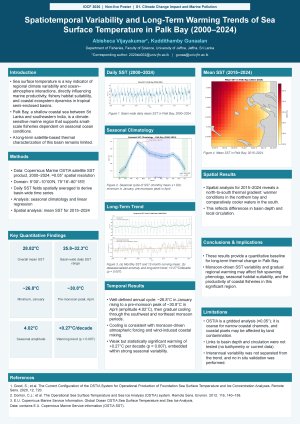
Basin-wide daily SST ranged from 25.8°C to 32.3°C over the 25-year record, with an overall mean of 28.82°C. The seasonal climatology reveals a well-defined annual cycle, with minimum temperatures of ~26.8°C in January rising to a pre-monsoon peak of ~30.8°C in April—a seasonal amplitude of 4.02°C—followed by gradual cooling through the southwest and northeast monsoon periods, consistent with monsoon-driven atmospheric forcing and wind-induced coastal mixing. Long-term regression analysis reveals a weak but statistically significant warming trend of +0.27°C per decade (p = 0.007), indicating a measurable climate signal embedded within strong seasonal variability. Spatial analysis for 2015–2024 reveals a north-to-south thermal gradient, with warmer conditions in the northern bay and comparatively cooler waters in the south, reflecting differences in basin depth and local circulation.
These results provide a quantitative baseline for long-term thermal change in Palk Bay and highlight how monsoon-driven SST variability and gradual regional warming may affect fish spawning phenology, seasonal habitat suitability, and the productivity of coastal fisheries in this significant region.
Keywords
Sea Surface Temperature
Palk Bay
Climate Variability
Monsoon Dynamics
Fisheries Habitat
Poster
PalkBay_SST_IOCF2026_Poster_final.pdf
Macroalgal Inclusion in Aquafeeds: A Strategy to Enhance Growth Performance, Feed Efficiency, and Immune Resilience in Mediterranean Teleost Fish
Composition and spatial variation of fish assemblages at two sites in the Paraguay River basin