Event submissions
Published
This submission belongs to the session S4. Behavioral Ecology of Aquatic Animals: Implications for Habitat Conservation and Ecosystem Services of the event The 1st International Online Conference on Fishes
Published date
03 Nov, 2026
Academic Editor
 Maria Angeles Esteban
Citation
Weslley Ramon Alves Macedo, Thomaz Jefrey Seren, Ariely Loyane Garcia Soares, Lucimara Araujo Ramos, Fernando Cesar Paiva D Agosta, Composition and spatial variation of fish assemblages at two sites in the Paraguay River basin, in Proceedings of The 1st International Online Conference on Fishes, 5 November–6 November 2026, MDPI: Basel, Switzerland
Share
Email
Facebook
Twitter
LinkedIn
Composition and spatial variation of fish assemblages at two sites in the Paraguay River basin

Weslley Ramon Alves Macedo 1
Thomaz Jefrey Seren 1
Ariely Loyane Garcia Soares 1
Lucimara Araujo Ramos 2
Fernando Cesar Paiva D Agosta 3
1. Graduate Program in Biodiversity and Environment (PPGBMA), Laboratory of Fish Biogeography and Systematics (LABISPE), Federal University of Grande Dourados, Dourados, Mato Grosso do Sul, Brazil.
2. Graduate Program in Biodiversity and Environment (PPGBMA), Federal University of Grande Dourados Foundation, Dourados, Mato Grosso do Sul, Brazil
3. Laboratory of Fish Biogeography and Systematics (LABISPE), Federal University of Grande Dourados, Dourados, Mato Grosso do Sul, Brazil.
Abstract
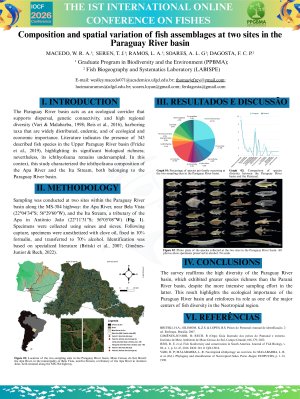
The Neotropical Region hosts the world’s greatest diversity of freshwater fish, with over 6,200 valid species distributed across major South American river basins. Among these, the Paraguay River basin, situated within the Pantanal biome, stands out for its high environmental heterogeneity, hydrological connectivity, and ecological importance in maintaining ichthyological biodiversity. Despite its significance, many tributaries within this basin remain undersampled, hindering the understanding of fish distribution patterns and the development of conservation strategies. Therefore, this study aimed to characterize the ichthyofauna composition of the Apa River and the Ita Stream, a tributary of the Apa, located in the Paraguay River basin in Mato Grosso do Sul, Brazil. Sampling was conducted at two distinct points using seines and hand nets. Specimens were anesthetized, fixed, and subsequently identified based on morphological characters, meristic data, and specialized literature. A total of 44 species were recorded, distributed across 5 orders and 19 families. Characiformes showed the highest richness with 25 species, followed by Siluriformes with 12 species, while the remaining orders included Cichliformes, Gymnotiformes, and Beloniformes. The high representation of Characiformes and Siluriformes follows the typical pattern observed in Neotropical freshwater environments. Furthermore, environmental differences between the Apa River and the Ita Stream directly influenced the composition of fish assemblages, highlighting the role of local ecological filters such as depth, water clarity, current, and substrate type. These results reinforce the importance of the Paraguay River basin for aquatic biodiversity conservation and contribute to the expansion of regional ichthyofauna knowledge, reducing sampling gaps in understudied tributaries.
Keywords
Aquatic conservation
Ecological filters
Neotropical ichthyofauna
Taxonomic diversity.
Poster
Banner ICtio.pdf
Spatiotemporal Variability and Long-Term Warming Trends of Sea Surface Temperature in Palk Bay (2000-2024)
Hybridization Dynamics in Declining Southernmost Atlantic Salmon Populations: 30-year study