Event submissions
Published
This submission belongs to the session S3. Genetics and Genomics of the event The 1st International Online Conference on Fishes
Published date
03 Nov, 2026
Academic Editor
 Eric Hallerman
Citation
Alvaro Gutierrez-Rodriguez, Camen Blanco-Fernandez, Eva Garcia-Vazquez, Gonzalo Machado-Schiaffino, Quantifying Epigenomic Responses to Environmental Change Across a 20-Year Window Study of DNA Methylation in Wild Salmo salar, in Proceedings of The 1st International Online Conference on Fishes, 5 November–6 November 2026, MDPI: Basel, Switzerland
Share
Email
Facebook
Twitter
LinkedIn
Quantifying Epigenomic Responses to Environmental Change Across a 20-Year Window Study of DNA Methylation in Wild Salmo salar

Alvaro Gutierrez-Rodriguez 1
Camen Blanco-Fernandez 1
Eva Garcia-Vazquez 1

Gonzalo Machado-Schiaffino 1
1. Department of Functional Biology, University of Oviedo. 33006-Oviedo, Spain
Abstract
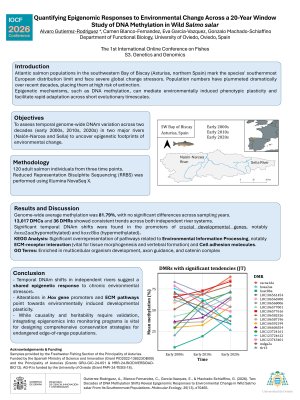
Atlantic salmon (Salmo salar) populations are experiencing significant declines across the North Atlantic. This trend is most acute in southernmost populations, such as those in the southwestern Bay of Biscay, which represent the species' upper thermal distribution limit. These populations are highly vulnerable to global change stressors, including rising temperatures and altered food webs. Epigenetic mechanisms, specifically DNA methylation, may mediate environmentally induced phenotypic plasticity and facilitate rapid adaptation to these shifting conditions. We utilized Reduced Representation Bisulphite Sequencing (RRBS) to examine genome-wide, single-base DNA methylation patterns in 120 adult salmon. The samples were collected from two river systems in northern Spain (Nalón-Narcea and Sella) across three time points spanning two decades (early 2000s, 2010s, and 2020s). The analysis focused on 715,240 common CpG sites to identify differentially methylated cytosines (DMCs) and regions (DMRs). Temporal analysis revealed significant convergent shifts in methylation between rivers, including the promoters of two Hox genes that are essential for embryonic development. Gene Ontology and KEGG enrichment analyses identified a significant overrepresentation of developmental pathways, most notably the ECM–receptor interaction pathway associated with morphogenesis and vertebral formation. Furthermore, enriched pathways related to environmental information processing and cell signaling suggest a robust epigenetic response to external stressors over the 20-year study period.
These findings provide compelling evidence of a temporal "epigenetic footprint" shaped by two decades of environmental change. These shifts likely arise from a combination of intra-generational induction and the potential inheritance of environmentally induced epimarks. Our results indicate that DNA methylation serves as a key mediator of phenotypic variation, potentially enhancing the adaptive capacity of declining southernmost salmon populations. This longitudinal study underscores the critical role of epigenomics in species resilience and highlights the necessity for functional research to establish causal links between specific stressors and methylation responses.
Keywords
DNA methylation
population epigenetics
Salmo salar
Global change
phenotypic plasticity
Poster
Poster_AGR_Fishes_2026_Salmosalar_DNAm.pdf
Hybridization Dynamics in Declining Southernmost Atlantic Salmon Populations: 30-year study
Integrating autonomous weighing, declaration and traceability workflows in small-scale fisheries: toward a hybrid declarative-observational compliance architecture