Event submissions
Published
This submission belongs to the session S2. Sustainable Fisheries and Aquaculture Innovations: Combating Overfishing and Advancing Aquatic Health of the event The 1st International Online Conference on Fishes
Published date
03 Nov, 2026
Academic Editor
 Wagner C. Valenti
Citation
Marcin Dębowski, Joanna Kazimierowicz, Coupling Aquaculture Effluent Bioremediation with Chlorella vulgaris Cultivation for Sustainable Bioenergy-Oriented Biomass Production, in Proceedings of The 1st International Online Conference on Fishes, 5 November–6 November 2026, MDPI: Basel, Switzerland
Share
Email
Facebook
Twitter
LinkedIn
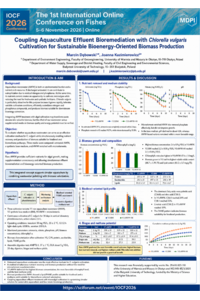
Coupling Aquaculture Effluent Bioremediation with Chlorella vulgaris Cultivation for Sustainable Bioenergy-Oriented Biomass Production

Marcin Dębowski 1

Joanna Kazimierowicz 2
1. Department of Environment Engineering, Faculty of Geoengineering, University of Warmia and Mazury in Olsztyn, 10-719 Olsztyn, Poland
2. Department of Water Supply, Sewerage and District Heating, Faculty of Civil Engineering and Environmental Sciences, Bialystok University of Technology, 15-351 Bialystok, Poland
Abstract
Aquaculture effluents are both an environmental burden and nutrient-rich resources that can be redirected toward circular biomass production. This study evaluated Chlorella vulgaris cultivation as an integrated strategy for aquaculture wastewater (AWW) treatment and the generation of biomass suitable for bioenergy applications. The microalga was cultivated in untreated AWW, microelement-enriched AWW, and a synthetic reference medium. The biomass production, nitrogen and phosphorus removal, biochemical composition, fatty acid methyl ester (FAME) profile, and anaerobic digestion potential were assessed. Untreated AWW provided the most favourable cultivation conditions, supporting the highest biomass concentration of 2.4 g VS/L. It also enabled efficient nutrient removal, with complete ammonia elimination, 93.7% phosphate removal, and 37.8% nitrate reduction. Supplementation with microelements did not improve algal growth or nutrient uptake, indicating that raw AWW supplied sufficient nutrients for C. vulgaris development. Biomass produced in AWW showed a lipid profile suitable for biodiesel production, dominated by C16:0 and C18:1 fatty acids. In addition, biomass cultivated in untreated AWW generated the highest biogas and methane yields, reaching 358 ± 11 L/kg VS and 216 ± 7 L/kg VS, respectively. The results demonstrate that aquaculture wastewater can be effectively used as a cultivation medium for C. vulgaris, enabling simultaneous effluent bioremediation, nutrient recovery, and bioenergy-oriented biomass production. This approach supports sustainable aquaculture innovation by reducing wastewater-related environmental impacts while producing valuable algal biomass for biodiesel and biomethane pathways. The proposed system may contribute to more circular, low-waste, and resource-efficient fish farming practices.
Keywords
Chlorella vulgaris
aquaculture effluent
sustainable aquaculture
nutrient recovery
algal biomass
biodiesel
biomethane
Poster
IOCF2026 Debowski, Kazimierowicz.pdf
Impact of Aflatoxin B1 on Growth, Hematological Indices, Oxidative Stress, and Gill Surface Ultrastructure in Channa punctata
Relationship between Tooth Replacement Rate and Tooth Size in Cichlid Fishes