Event submissions
Published
This submission belongs to the session S1. Climate Change Impact and Marine Pollution of the event The 1st International Online Conference on Fishes
Published date
03 Nov, 2026
Academic Editor
 Pedro Morais
Citation
Abdulwaris Tijani, Gbenga Ayodele, SYNERGISTIC EFFECT OF CLIMATE CHANGE AND ANTIBIOTIC POLLUTION ON FISH HEALTH - A SYSTEMATIC REVIEW, in Proceedings of The 1st International Online Conference on Fishes, 5 November–6 November 2026, MDPI: Basel, Switzerland
Share
Email
Facebook
Twitter
LinkedIn
SYNERGISTIC EFFECT OF CLIMATE CHANGE AND ANTIBIOTIC POLLUTION ON FISH HEALTH - A SYSTEMATIC REVIEW

Abdulwaris Tijani 1
Gbenga Ayodele 1
1. Department of Animal Production and Health, Federal University of Technology, Akure, Nigeria
Abstract
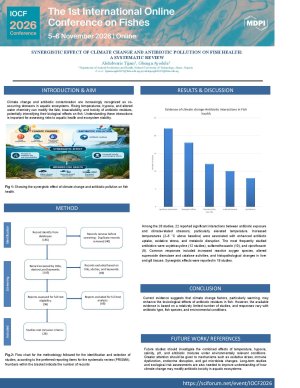
Climate change and antibiotic contamination are increasingly recognized as co-occurring stressors in aquatic ecosystems. Rising temperatures, hypoxia, and altered water chemistry can modify the fate, bioavailability, and toxicity of antibiotic residues, potentially intensifying their biological effects on fish. Understanding these interactions is essential for assessing risks to aquatic health and ecosystem stability.
A systematic review was conducted following PRISMA 2020 guidelines. Scopus, Web of Science, PubMed, and Google Scholar were searched for peer-reviewed studies published between 2015 and 2025 using keywords including antibiotic residues, climate change, temperature, ecotoxicology, and combined effects. Eligible studies included experimental and field investigations assessing the combined effects of antibiotic exposure and climate-related stressors on fish. Reviews, non-fish studies, and studies evaluating only a single stressor were excluded. Out of 185 records, 145 remained after duplicate removal. Following title and abstract screening, 96 full-text articles were assessed, and 28 studies met the inclusion criteria for qualitative synthesis.
Among the 28 studies, 22 reported significant interactions between antibiotic exposure and climate-related stressors, particularly elevated temperature. Increased temperatures (2–6 °C above baseline) were associated with enhanced antibiotic uptake, oxidative stress, and metabolic disruption. The most frequently studied antibiotics were oxytetracycline (12 studies), sulfamethoxazole (10), and ciprofloxacin (8). Common responses included increased reactive oxygen species, altered superoxide dismutase and catalase activities, and histopathological changes in liver and gill tissues. Synergistic effects were reported in 18 studies.
Current evidence suggests that climate change factors, particularly warming, may enhance the toxicological effects of antibiotic residues in fish. However, the available evidence is based on a relatively limited number of studies, and responses vary with antibiotic type, fish species, and environmental conditions. Further standardized studies are needed to strengthen integrated environmental risk assessment.
Keywords
Antibiotic residues
Climate change
Synergistic effects
Fish health
Aquatic ecotoxicology
Biomarkers
Temperature stress
Oxidative stress
Aquatic pollution
Poster
conference .pdf
Relationship between Tooth Replacement Rate and Tooth Size in Cichlid Fishes
Dietary supplementation with Phaeodactylum tricornutum improves skeletal health in zebrafish