Event submissions
Published
This submission belongs to the session S2. Sustainable Fisheries and Aquaculture Innovations: Combating Overfishing and Advancing Aquatic Health of the event The 1st International Online Conference on Fishes
Published date
03 Nov, 2026
Academic Editor
 Wagner C. Valenti
Citation
Daniela Tomás de Castro, Gil Martins, Bruno Pinto, Jorge Dias, Hugo Pereira, Paulo Gavaia, Dietary supplementation with Phaeodactylum tricornutum improves skeletal health in zebrafish, in Proceedings of The 1st International Online Conference on Fishes, 5 November–6 November 2026, MDPI: Basel, Switzerland
Share
Email
Facebook
Twitter
LinkedIn
Dietary supplementation with Phaeodactylum tricornutum improves skeletal health in zebrafish

Daniela Tomás de Castro 1,2,3
Gil Martins 3
Bruno Pinto 4
Jorge Dias 5
Hugo Pereira 2

Paulo Gavaia 2,3,6
1. FCT, Universidade do Algarve,Faro,8005-139, Portugal
2. GreenCoLab, University of Algarve, Faro, 8005-139, Portugal
3. Centre of Marine Sciences, University of Algarve, Faro, 8005-139, Portugal
4. Necton S.A., Olhão, 8700-152 Portugal
5. SPAROS, LDA, Olhão,8700-221 Portugal
6. Faculty of Medicine and Biomedical Sciences, University of Algarve, Faro, 8005-139, Portugal
Abstract
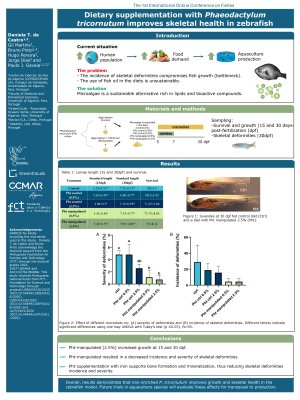
The human populationgrowing is increasing pressure on food production systems. Aquaculture has emerged as a key and sustainable provider of high-quality nutrition; however, its further development is constrained by several challenges. Among these, the reliance on fish oil as a major ingredient in aquafeeds stands out as a critical limitation. Microalgae offer a promising alternative, as they are naturally abundant in essential amino acids, vitamins, pigments, and a wide range of bioactive compounds. These bioactives are of particular interest due to their potential to improve skeletal health in fish—a major issue in aquaculture that frequently leads to deformities, stock losses, and reduced economic returns. In this context, zebrafish constitutes a well-established experimental model, sharing genetic similarities with many farmed fish species, and enabling rapid and robust evaluation of nutritional strategies and their biological effects.
Freeze-dried P. tricornutum biomass, produced under either standard culture conditions or in iron- and nitrogen-enriched medium, was incorporated into microdiets at two inclusion levels (0.5% and 2.5%). Zebrafish larvae were co-fed with rotifers and microdiets until 8 days post-fertilisation (dpf), after which they were fed exclusively with microdiets until 30 dpf. Growth performance was assessed at 15 and 30 dpf, whereas survival and skeletal condition were evaluated at 30 dpf.
At 30 dpf, the larvae fed diet with P. tricornutum (2.5%) were significantly longer than the other groups. No significant differences were observed in the incidence of skeletal malformations, but severity was higher in fish fed with P. tricornutum (0.5%) and fish fed with microdiet control. Even though not significantly different, fish fed with diets containing P. tricornutum (0.5 and 2.5%) had a lower number of deformed fish. Overall, our results demonstrated that a diet supplemented with P. tricornutum 2,5% improved growth and contributed to better fish skeletal health.
Keywords
microalgae
skeletal deformities
zebrafish
Poster
poster_1st international fish conference_DanielaCastro.pdf
SYNERGISTIC EFFECT OF CLIMATE CHANGE AND ANTIBIOTIC POLLUTION ON FISH HEALTH - A SYSTEMATIC REVIEW
Population Parameters and Health Status of Mudskipper, Apocryptes bato (Hamilton, 1822), sourced from the Poshur River, Southwestern Bangladesh: A Baseline Study for Sustainable Management