Event submissions
Published
This submission belongs to the session S2. Sustainable Fisheries and Aquaculture Innovations: Combating Overfishing and Advancing Aquatic Health of the event The 1st International Online Conference on Fishes
Published date
03 Nov, 2026
Academic Editor
 Wagner C. Valenti
Citation
MEHENAZ AFRIN KHAN ZHILICK, Population Parameters and Health Status of Mudskipper, Apocryptes bato (Hamilton, 1822), sourced from the Poshur River, Southwestern Bangladesh: A Baseline Study for Sustainable Management, in Proceedings of The 1st International Online Conference on Fishes, 5 November–6 November 2026, MDPI: Basel, Switzerland
Share
Email
Facebook
Twitter
LinkedIn
Population Parameters and Health Status of Mudskipper, Apocryptes bato (Hamilton, 1822), sourced from the Poshur River, Southwestern Bangladesh: A Baseline Study for Sustainable Management

MEHENAZ AFRIN KHAN ZHILICK 1
1. Fisheries and Marine Resource Technology Discipline, Khulna University, Khulna 9208, Bangladesh
Abstract
Introduction:
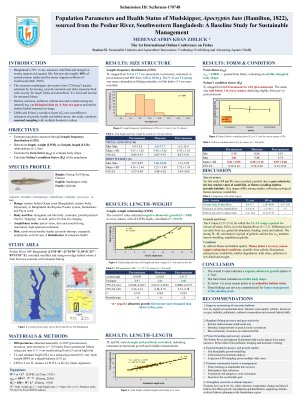
The mudskipper, Apocryptes bato (Hamilton, 1822), is an important estuarine species under the family Gobiidae, playing a vital role in the coastal food web of Bangladesh. Despite its ecological and commercial importance, detailed information on its population dynamics in the Poshur River is limited. This study was conducted to estimate critical population parameters, including growth patterns, length–length relationships (LLRs), and health indices, to support effective fisheries management.
Methods:
A total of 300 specimens were collected from the Poshur River on a seasonal basis (pre-monsoon, monsoon, and post-monsoon) during 2025. Total length (TL) and body weight (BW) were measured with high precision (0.01 cm and 0.01 g, respectively). Growth patterns were analyzed using the length–weight relationship (W = aLb), while health status was evaluated through Fulton’s condition factor (KF) and form factor (a3.0).
Results:
The total length of the specimens ranged from 5.9 to 17.7 cm, and body weight varied from 1.38 to 18.96 g. The overall allometric coefficient (b) was calculated as 2.6, indicating a significant negative allometric growth pattern (b < 3.0), where the fish becomes more slender as it increases in length. The LLR showed a strong correlation with r2 = 0.945. The calculated form factor (a3.0) was 0.0033, confirming an elongated, eel-like body shape. Mean Fulton’s condition factor was recorded below 1.0, suggesting that the physiological health of the population is suboptimal, likely due to environmental stressors in the estuarine habitat.
Conclusions:
These findings provide the first comprehensive seasonal baseline on the population parameters of A. bato in the Poshur River. The observed growth patterns and health indices are crucial for implementing sustainable management strategies and monitoring the ecological health of the southwestern coastal ecosystems of Bangladesh.
Keywords
Apocryptes bato
Negative allometric growth
Form factor
F ulton’s condition factor
Poshur River.
Poster
Poster_Apocryptes_bato_Sciforum-170748.pdf
Dietary supplementation with Phaeodactylum tricornutum improves skeletal health in zebrafish
Modeling Climate-Driven Profit and Biomass Dynamics in Moroccan Sardine Fisheries: A Markov Chain Perspective