Event submissions
Published
This submission belongs to the session S2. Sustainable Fisheries and Aquaculture Innovations: Combating Overfishing and Advancing Aquatic Health of the event The 1st International Online Conference on Fishes
Published date
03 Nov, 2026
Academic Editor
 Wagner C. Valenti
Citation
Amanda Azevedo, Alicya Carvalho, Camila Pereira, Maria Eduarda Soares Da Silva, Maria Alzirene Ferreira, Kevin Vasconcelos, Elideth Pacheco Monteiro, Weverton Santos, José Neto, Michele Velasco, Multiparasitism by myxosporeans in Jacundá (Crenicichla lugubris Heckel, 1840) from the Arapiranga River, Brazilian Amazon region, in Proceedings of The 1st International Online Conference on Fishes, 5 November–6 November 2026, MDPI: Basel, Switzerland
Share
Email
Facebook
Twitter
LinkedIn
Multiparasitism by myxosporeans in Jacundá (Crenicichla lugubris Heckel, 1840) from the Arapiranga River, Brazilian Amazon region

Amanda Azevedo 1
Alicya Carvalho 2
Camila Pereira 3
Maria Eduarda Soares Da Silva 4
Maria Alzirene Ferreira 1
Kevin Vasconcelos 1
Elideth Pacheco Monteiro 5
Weverton Santos 6
José Neto 1
Michele Velasco 1
1. Federal Rural University of the Amazon (UFRA), Postgraduate Program in Animal Reproduction in the Amazon (PPGREPROAMAZON), Belém, Pará, Brazil
2. Federal Rural University of the Amazon (UFRA), Belém, Pará, Brazil
3. Federal University of Pará (UFPA), Postgraduate Program Biodiversity and Biotechnology (PPG-BIONORTE), Belém, Pará, Brazil
4. Federal Rural University of the Amazon (UFRA), Postgraduate Program in Animal Health and Production in the Amazon (PPGSPAA), Belém, Pará, Brazil
5. Federal University of Pará (UFPA), Marine and Coastal Studies Group (GEMC), Belém, Pará, Brazil
6. Federal University of Pará (UFPA), Postgraduate Program in Aquatic Ecology and Fisheries (PPGEAP), Belém, Pará, Brazil
Abstract
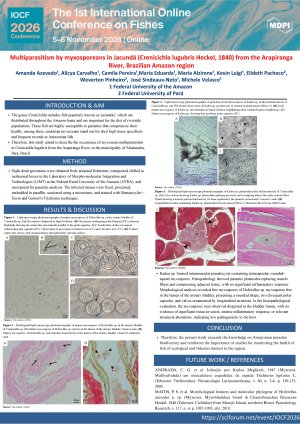
The genus Crenicichla includes fish popularly known as 'jacundás', which are distributed throughout the Amazon basin and are important for the diet of riverside populations. These fish are highly susceptible to parasites that compromise their health;, among these, cnidarian myxozoans stand out for their high tissue specificity and frequent records in Amazonian fish. Therefore, this study aimed to describe the occurrence of myxozoan multiparasitism in Crenicichla lugubris from the Arapiranga River, in the municipality of Abaetetuba, Pará, Brazil. Eight dead specimens were obtained from artisanal fishermen, transported chilled in isothermal boxes to the Laboratory of Morpho-molecular Integration and Technologies (LIMT) at the Federal Rural University of the Amazon (UFRA), and necropsied for parasitic analysis. The infected tissues were fixed, processed, embedded in paraffin, sectioned using a microtome, and stained with Hematoxylin–-Eosin and Gomori's Trichrome techniques. Kudoa sp. was identified in the skeletal musculature and Hoferellus sp. in the urinary bladder, with prevalences of 62.5% and 37.5%, respectively. Kudoa sp. formed intramuscular pseudocysts containing tetracapsular, rounded-square myxospores. Histopathology showed parasitic plasmodia replacing muscle fibers and compressing adjacent tissue, with no significant inflammatory response. Morphological analysis revealed free myxospores of Hoferellus sp. myxospores free in the lumen of the urinary bladder, presenting a rounded shape, two divergent polar capsules, and valves ornamented by longitudinal striations. In the histopathological evaluation, the myxospores were observed dispersed in the bladder lumen, with no evidence of significant tissue invasion, intense inflammatory response, or relevant structural alterations, indicating low pathogenicity to the host. The results highlight the tissue specificity of these myxozoans and demonstrate the simultaneous occurrence of different parasitic species in a single host. Therefore, the present study expands the knowledge on Amazonian parasitic biodiversity and reinforces the importance of studies for monitoring the health of fish of ecological and fisheries interest in the region.
Keywords
Fish
Amazon
Parasites.
Poster
POSTER IOCF.pdf
Modeling Climate-Driven Profit and Biomass Dynamics in Moroccan Sardine Fisheries: A Markov Chain Perspective
Hepatic coccidiosis by Calyptospora spp. (Apicomplexa: Calyptosporidae) in cichlids and sciaenids from the Lower Tocantins region, Pará, Brazil