Event submissions
Published
This submission belongs to the session S2. Sustainable Fisheries and Aquaculture Innovations: Combating Overfishing and Advancing Aquatic Health of the event The 1st International Online Conference on Fishes
Published date
03 Nov, 2026
Academic Editor
 Wagner C. Valenti
Citation
Maria Eduarda Soares da Silva, Camila Maria Barbosa Pereira, Kevin Luigi Vasconcelos, Maria Alzirene Souza Ferreira, Amanda Queiroz Azevedo, Elideth Pacheco Monteiro, Weverton John Santos, Alicya Carvalho, Michele Velasco, Jose Ledamir Sindeaux-Neto, Hepatic coccidiosis by Calyptospora spp. (Apicomplexa: Calyptosporidae) in cichlids and sciaenids from the Lower Tocantins region, Pará, Brazil, in Proceedings of The 1st International Online Conference on Fishes, 5 November–6 November 2026, MDPI: Basel, Switzerland
Share
Email
Facebook
Twitter
LinkedIn
Hepatic coccidiosis by Calyptospora spp. (Apicomplexa: Calyptosporidae) in cichlids and sciaenids from the Lower Tocantins region, Pará, Brazil

Maria Eduarda Soares da Silva 1
Camila Maria Barbosa Pereira 2
Kevin Luigi Vasconcelos 3
Maria Alzirene Souza Ferreira 3
Amanda Queiroz Azevedo 3
Elideth Pacheco Monteiro 4
Weverton John Santos 5
Alicya Carvalho 6
Michele Velasco 3
Jose Ledamir Sindeaux-Neto 1
1. Federal Rural University of the Amazon (UFRA), Postgraduate Program in Animal Health and Production
in the Amazon (PPGSPAA), Belém, Pará, Brazil
2. Federal University of Pará (UFPA), Postgraduate Program Biodiversity and Biotechnology (PPG-BIONORTE), Belém, Pará, Brazil
3. Federal Rural University of the Amazon (UFRA), Postgraduate Program in Animal Reproduction
in the Amazon (PPGREPROAMAZON), Belém, Pará, Brazil
4. Federal University of Pará (UFPA), Marine and Coastal Studies Group (GEMC), Belém, Pará, Brazil
5. Federal University of Pará (UFPA), Postgraduate Program in Aquatic Ecology and Fisheries (PPGEAP), Belém, Pará, Brazil
6. Instituto da Saúde e Produção Animal, Federal Rural University of the Amazon (UFRA), Belém, Pará, Brazil
Abstract
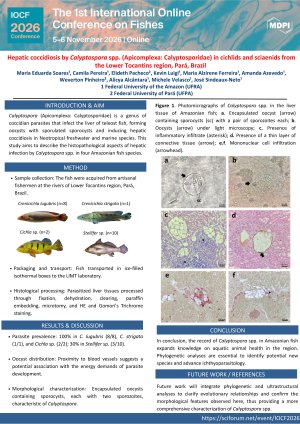
Calyptospora (Apicomplexa: Calyptosporidae) is a genus of coccidian parasites that infect the liver of teleost fish, forming oocysts with sporulated sporocysts and inducing hepatic coccidiosis in neotropical freshwater and marine species. This study aims to describe the histopathological aspects of hepatic infection by Calyptospora spp. in four Amazonian fish species. A total of 21 specimens were acquired from artisanal fishermen, including the cichlids Crenicichla lugubris (n=8), Crenicichla strigata (n=1), and Cichla sp. (n=2), and the sciaenid Stellifer sp. (n=10). The fish were stored in isothermal boxes containing ice and transported to the Laboratory of Morphomolecular Integration and Technologies, affiliated with the Federal Rural University of the Amazon (LIMT/UFRA), for necropsy. Parasitized liver tissues were selected for histological processing, consisting of fixation, alcohol dehydration, clearing, paraffin embedding, microtomy, and staining with Hematoxylin–Eosin and Gomori's Trichrome. The parasite prevalence in the hosts was: 100% (8/8) for C. lugubris, 100% (1/1) for C. strigata, 100% (2/2) for Cichla sp., and 30% (3/10) for Stellifer sp. Morphological analysis revealed oocysts and free sporocysts diffusely distributed throughout the hepatic parenchyma. The observed morphology was characteristic of the genus Calyptospora, evidenced by encapsulated oocysts containing sporocysts with a pair of sporozoites each. Additionally, intense blackened pigmentation associated with melanomacrophage centers was observed. Histopathological analysis revealed mature oocysts distributed among hepatocytes and adjacent to blood vessels, frequently encapsulated by a thin layer of connective tissue, and the presence of a mononuclear inflammatory infiltrate, indicating host immuno-responsive activity against parasitism. The proximity of the oocysts to vascular structures suggests an association with the energy demand required for parasite development. In conclusion, the record of Calyptospora spp. in Amazonian fish expands the knowledge on the health of aquatic organisms in the region. Furthermore, phylogenetic analyses are essential to elucidate potential new species and further advance studies in ichthyoparasitology.
Keywords
fish
Amazon
liver
Calyptospora
coccidiosis
Poster
POSTER_IOCF.pdf
Multiparasitism by myxosporeans in Jacundá (Crenicichla lugubris Heckel, 1840) from the Arapiranga River, Brazilian Amazon region