Event submissions
Published
This submission belongs to the session S2. Sustainable Fisheries and Aquaculture Innovations: Combating Overfishing and Advancing Aquatic Health of the event The 1st International Online Conference on Fishes
Published date
04 Nov, 2026
Academic Editor
 Wagner C. Valenti
Contribution&Funding
Conceptualization,
[María Isabel Sáez Casado] ; [Tomas Francisco Martínez Moya] ; [Marta Arizcun Arizcun] ; [Elena Chaves-Pozo] ; [Maria Dolores Ayala]
Methodology,
[Tomas Francisco Martínez Moya] ; [María Isabel Sáez Casado] ; [Isabel M. Cerezo] ; [Marta Arizcun Arizcun] ; [Javier Sabio Sánchez] ; [Maria Dolores Ayala] ; [Elena Chaves-Pozo]
Formal analysis,
[Javier Sabio Sánchez] ; [María Isabel Sáez Casado] ; [Isabel M. Cerezo]
Investigation,
[Javier Sabio Sánchez] ; [Maria Dolores Ayala] ; [Isabel M. Cerezo]
Resources,
[Tomas Francisco Martínez Moya] ; [Elena Chaves-Pozo] ; [Maria Dolores Ayala] ; [Marta Arizcun Arizcun] ; [María Isabel Sáez Casado]
Data curation,
[María Isabel Sáez Casado] ; [Isabel M. Cerezo] ; [Javier Sabio Sánchez]
Writing - original draft,
[Javier Sabio Sánchez]
Writing - review,
[editing] ; [María Isabel Sáez Casado]
Visualization,
[Javier Sabio Sánchez] ; [Isabel M. Cerezo]
Supervision,
[María Isabel Sáez Casado] ; [Maria Dolores Ayala] ; [Tomas Francisco Martínez Moya] ; [Marta Arizcun Arizcun] ; [Elena Chaves-Pozo]
Project administration,
[Tomas Francisco Martínez Moya] ; [Marta Arizcun Arizcun] ; [Elena Chaves-Pozo] ; [María Isabel Sáez Casado]
Funding acquisition,
[Tomas Francisco Martínez Moya] ; [Marta Arizcun Arizcun] ; [Elena Chaves-Pozo] ; [María Isabel Sáez Casado]
Funding: This research has been carried out within the scope of the project funded by the Spanish Ministry of Science, Innovation and Universities (HYDROALGAE4BREAM, PID2021- 122287OB-C21).
Citation
Javier Sabio Sánchez, Isabel M. Cerezo, Elena Chaves-Pozo, Maria Dolores Ayala, Marta Arizcun Arizcun, Tomas Francisco Martínez Moya, María Isabel Sáez Casado, Short- and medium-term effects of raw and hydrolyzed microalgae inclusion on fatty acid profile, intestinal functionality, and gene expression in gilthead seabream (Sparus aurata), in Proceedings of The 1st International Online Conference on Fishes, 5 November–6 November 2026, MDPI: Basel, Switzerland
Share
Email
Facebook
Twitter
LinkedIn
Short- and medium-term effects of raw and hydrolyzed microalgae inclusion on fatty acid profile, intestinal functionality, and gene expression in gilthead seabream (Sparus aurata)

Javier Sabio Sánchez 1
Isabel M. Cerezo 1,2
Elena Chaves-Pozo 3
Maria Dolores Ayala 4
Marta Arizcun Arizcun 3
Tomas Francisco Martínez Moya 1
María Isabel Sáez Casado 1
1. Department of Biology and Geology, Escuela Superior de Ingeniería, University of Almería, Almería, 04120, Spain
2. Oceanographic Center of Málaga, Spanish Institute of Oceanography (IEO), Consejo Superior de Investigaciones Científicas (CSIC), Málaga, 29002, Spain
3. Oceanographic Center of Murcia, Spanish Institute of Oceanography (COMU-IEO), Consejo Superior de Investigaciones Científicas (CSIC), Murcia, 30860, Spain
4. Departament of Anatomía y Anatomía Patológica Comparadas, University of Murcia, Murcia, 30100, Spain
Abstract
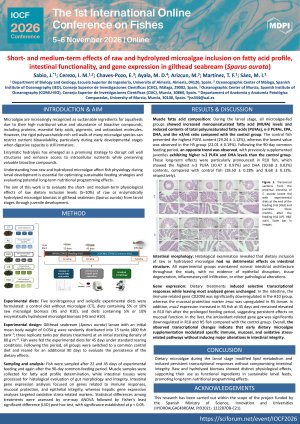
Introduction: Microalgae are promising functional ingredients for sustainable aquafeeds, but the resistant cell wall of some species may limit nutrient availability during larval development. This study evaluated the short- and medium-term effects of low dietary inclusion levels of raw or enzymatically hydrolyzed microalgal biomass in gilthead seabream (Sparus aurata).
Methods: Larvae (initial weight: 0.034 g) were fed for 45 days with a control diet or diets containing 5% or 10% raw (R5, R10) or hydrolyzed (H5, H10) microalgae and were evaluated in triplicate (3 tanks per dietary treatment; n =400 fish/tank; initial density 80 g m⁻³). Fish were sampled after 22 and 45 days and then reared for an additional 90 days on a common control diet to assess prolonged effects. Muscle fatty acid profiles, intestinal morphology, and intestinal and hepatic gene expression were analyzed. The significant differences between fish fed different dietary treatments were detected by ANOVA and calculated with Fisher’s least significant difference (LSD) post hoc test (p < 0.05) using SPSS version 25 (IBM Corporation Inc).
Results: Microalgae supplementation altered muscle fatty acid composition. In larvae, all supplemented diets increased MUFAs and reduced PUFAs, n-3 PUFAs, EPA, DHA, and the n3/n6 ratio compared with the control (29.24 ± 1.12 % PUFAs), with the lowest PUFA levels observed in H5 (22.01 ± 0.19 %). After the prolonged phase, previously supplemented juveniles showed higher n-3 PUFA and DHA contents than controls (18.50 ± 0.28 % and 8.68 ± 0.12 %, respectively), especially R10 (20.47 ± 0.97 % and 10.68 ± 0.02 %, respectively). Intestinal morphology remained normal in all treatments, with no signs of damage or inflammation. Intestinal gene expression was mostly unchanged, except for significant CD209d downregulation in H10. Conversely, imuc was upregulated in R5 larvae, while muc2 increased in R5 at 45 days and R10 juveniles. Hepatic gpx was significantly downregulated in R10 and H5 compared with CT.
Conclusions: Dietary microalgae during the larval stage modified lipid metabolism and induced persistent transcriptional responses without compromising intestinal integrity. Raw and hydrolyzed biomass showed distinct physiological effects, supporting their use as functional ingredients in sustainable larval feeds.
Keywords
digestive functionality
functional feed
intestinal integrity
prolonged effects
transcriptional response
Poster
IOCF26_JSS_Larvae_Poster.pdf
Hepatic coccidiosis by Calyptospora spp. (Apicomplexa: Calyptosporidae) in cichlids and sciaenids from the Lower Tocantins region, Pará, Brazil
Early-Life Microbial Responses to Environmentally Relevant 17α-Ethinylestradiol Exposure in Danio rerio and Kryptolebias marmoratus