Event submissions
Published
This submission belongs to the session S2. Sustainable Fisheries and Aquaculture Innovations: Combating Overfishing and Advancing Aquatic Health of the event The 1st International Online Conference on Fishes
Published date
04 Nov, 2026
Academic Editor
 Wagner C. Valenti
Contribution&Funding
Conceptualization,
[M Angeles Esteban] ; [Álvaro Sánchez-Ferrer]
Methodology,
[M Angeles Esteban] ; [Lucía Hernández-Rodríguez] ; [Álvaro Sánchez-Ferrer]
Validation,
[M Angeles Esteban] ; [Álvaro Sánchez-Ferrer]
Data curation,
[Lucía Hernández-Rodríguez]
Writing - original draft,
[Lucía Hernández-Rodríguez]
Writing - review,
[editing] ; [Lucía Hernández-Rodríguez]
Visualization,
[Lucía Hernández-Rodríguez]
Supervision,
[M Angeles Esteban] ; [Álvaro Sánchez-Ferrer]
Project administration,
[M Angeles Esteban] ; [Álvaro Sánchez-Ferrer]
Funding acquisition,
[M Angeles Esteban] ; [Álvaro Sánchez-Ferrer]
Funding: This work was funded by the MICIU (PID2024-156529NB-I00) and Fundación Séneca of the Region of Murcia (23025/GERM/25).
Citation
Lucía Hernández-Rodríguez, M Angeles Esteban, Álvaro Sánchez-Ferrer, The Evolution of the Skeletal Muscle as an Immunologically Active Tissue in Teleost Fish, in Proceedings of The 1st International Online Conference on Fishes, 5 November–6 November 2026, MDPI: Basel, Switzerland
Share
Email
Facebook
Twitter
LinkedIn
The Evolution of the Skeletal Muscle as an Immunologically Active Tissue in Teleost Fish

Lucía Hernández-Rodríguez 1

M Angeles Esteban 1
Álvaro Sánchez-Ferrer 2
1. Department of Cell Biology and Histology, Faculty of Biology, University of Murcia, Murcia, 30100, Spain
2. Department of Biochemistry and Molecular Biology, Faculty of Biology, University of Murcia, Murcia, 30100, Spain
Abstract
Introduction
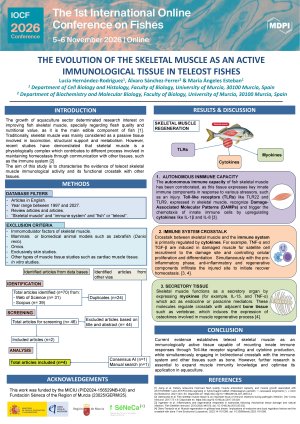
Global aquaculture growth has driven extensive research on teleost skeletal muscle, regarding its growth and flesh quality. Traditionally, research focused solely on the skeletal muscle functions related to movement and metabolism. However, recent studies demonstrated that this tissue is physiologically complex and is actively involved in maintaining homeostasis through intercommunication with other tissues, including the immune system. Therefore, this review aims to characterise the evidence of teleost skeletal muscle immunological activity and its functional crosstalk with other tissues.
Methods
PRISMA 2020 was used for this review. A literature search was conducted using different databases, such as Scopus and Web of Science, complemented by AI-assisted screening tools. Relevant studies were selected based on predefined inclusion and exclusion criteria of this review.
Results
Fish skeletal muscle can express and secrete immune-related molecules, establishing it as an immunologically active tissue in fish. Preliminary studies indicate that teleost skeletal muscles respond to diverse stressors by upregulating key immune components, including Toll-like receptors (TLRs) and proinflammatory cytokines, which is also observed in in vitro primary cell cultures, confirming this muscle-autonomous immune capacity. Skeletal muscle is also increasingly recognized as a secretory tissue that releases myokines, metabolites, and extracellular vesicles to communicate with the immune system. In mammals, skeletal muscle is an essential source of IL-6 with anti-inflammatory properties that regulate immune cell function after tissue injury and during healing; however, this has not been corroborated in fish.
Conclusions
In conclusion, current evidence establishes teleost skeletal muscle as an immunologically active tissue capable of mounting innate immune responses through Toll-like receptor signalling and proinflammatory cytokine production, while simultaneously engaging in bidirectional metabolic and signalling crosstalk with the immune system. However, further research is essential to expand our knowledge of muscle immunity and optimise its application in aquaculture.
Keywords
immune system
Skeletal muscle
Immune response
Tissue crosstalk
Teleost
Aquaculture
Immunologically active tissue
Poster
poster fishes v3 28.10.2026 Lucia.pdf
Early-Life Microbial Responses to Environmentally Relevant 17α-Ethinylestradiol Exposure in Danio rerio and Kryptolebias marmoratus
Biological heritage, water quality, and vulnerability factors of the Amghass water bodies (Middle Atlas, Morocco): an integrated assessment of a high-altitude hydrosystem subject to anthropogenic and climatic pressures.