Event submissions
Published
This submission belongs to the session Session 4. Physical Organic Chemistry of the event The 30th International Electronic Conference on Synthetic Organic Chemistry
Published date
06 Nov, 2026
Academic Editor
 Julio A. Seijas
Citation
Olumakinde Charles Omiyale, Selective Non-Covalent Recognition of Bioactive Organic Ligands by Silver-Doped Hydroxyapatite: A Physical-Organic Analysis of Substituent- and Functional-Group-Dependent Adsorption, in Proceedings of The 30th International Electronic Conference on Synthetic Organic Chemistry, 5 November–19 November 2026, MDPI: Basel, Switzerland
Share
Email
Facebook
Twitter
LinkedIn
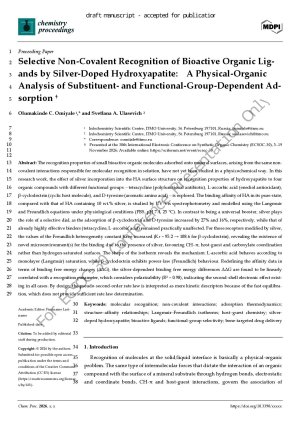
Selective Non-Covalent Recognition of Bioactive Organic Ligands by Silver-Doped Hydroxyapatite: A Physical-Organic Analysis of Substituent- and Functional-Group-Dependent Adsorption

Olumakinde Charles Omiyale 1
1. Infochemistry Scientific Centre, ITMO University, Saint Petersburg 197101, Russia
Abstract
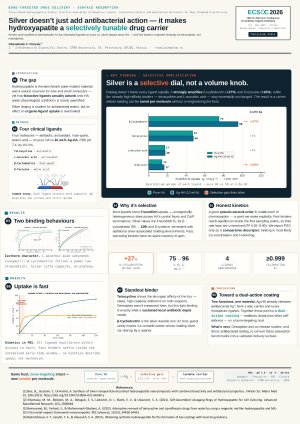
The binding of small bioactive organic molecules to mineral surfaces at interfaces is driven by the same non-covalent forces that govern molecular recognition in solution. However, this process is seldom analyzed from a physicochemical perspective. We investigate how silver doping alters the recognition behaviour of hydroxyapatite toward four different organic ligands with varied functional groups: tetracycline (a polyfunctional antibiotic), L-ascorbic acid (an enediol antioxidant), β-cyclodextrin (a cyclic host molecule), and D-tyrosine (an aromatic amino acid). Using UV-Vis spectroscopy and modelling with Langmuir and Freundlich isotherms, we compare equilibrium uptake on pristine and 10 wt.% Ag-doped apatite. Notably, silver acts as a selective modifier rather than a general enhancer: uptake of β-cyclodextrin and D-tyrosine increases by 27% and 16%, respectively, while high-affinity binders remain unaffected. The Freundlich heterogeneity parameters increase specifically for silver-responsive ligands (KF 95→109), indicating the formation of new Ag-related microenvironments that favour CH–π, host–guest, and carboxylate interactions over hydrogen bonds. The shape of the adsorption isotherm reveals the binding mechanism: L-ascorbic acid follows monolayer (Langmuir) saturation, whereas β-cyclodextrin exhibits a power-law (Freundlich) profile, suggesting a distribution of energetically diverse sites. We treat pseudo-second-order kinetics as comparative descriptors rather than definitive evidence of chemisorption, acknowledging the rapid equilibrium that makes rate laws ambiguous. This structure–affinity map, resolved by functional groups, links molecular architecture to interfacial thermodynamics, providing insights for designing tunable bone-targeting drug carriers and illustrating how doping influences non-covalent recognition on oxide surfaces.
Keywords
molecular recognition
non-covalent interactions
adsorption thermodynamics
structure–affinity relationships
Langmuir–Freundlich isotherms
host–guest chemistry
silver-doped hydroxyapatite
bioactive ligands
functional-group selectivity
bone-targeted
Manuscript
[Sciforum-199176] - [Manuscript PDF] - [Submission accepted].pdf
Poster
Final Selective_Non_Covalent_Ag_HA_Poster_ECSOC2026_portrait.pdf
Preparation of bioplastic by using Gracilaria verrucosa.