Event submissions
Published
 10.3390/chemproc2026022097 (registering DOI)
This submission belongs to the session Session 3. Design and Application of Organic/Supramolecular Assemblies of the event The 30th International Electronic Conference on Synthetic Organic Chemistry
Published date
10 Nov, 2026
Academic Editor
 Julio A. Seijas
Citation
Jhair C. Leon Jaramillo, Andres Calosso, Daniel A. Heredia, Miguel Gervaldo, Javier E. Durantini, Synthesis and Electropolymerization of a Naphthalene Diimide derivative Dicarbazole-Functionalized NDI-2CBZ. n-p Dopable Electropolymer with Electrochromic and Supercapacitive Properties., in Proceedings of The 30th International Electronic Conference on Synthetic Organic Chemistry, 5 November–19 November 2026, MDPI: Basel, Switzerland, doi: 10.3390/chemproc2026022097
Share
Email
Facebook
Twitter
LinkedIn
Synthesis and Electropolymerization of a Naphthalene Diimide derivative Dicarbazole-Functionalized NDI-2CBZ. n-p Dopable Electropolymer with Electrochromic and Supercapacitive Properties.

Jhair C. Leon Jaramillo 1

Andres Calosso 2

Daniel A. Heredia 2
Miguel Gervaldo 1

Javier E. Durantini 1
1. IITEMA-CONICET, Departamento de Química, Facultad de Ciencias Exactas Físico-Químicas y Naturales, Universidad Nacional de Río Cuarto, Agencia Postal Nro. 3, X5804BYA Río Cuarto, Córdoba, Argentina.
2. IDAS-CONICET, Departamento de Química, Facultad de Ciencias Exactas Físico-Químicas y Naturales, Universidad Nacional de Río Cuarto, Agencia Postal Nro. 3, X5804BYA Río Cuarto, Córdoba, Argentina.
Abstract
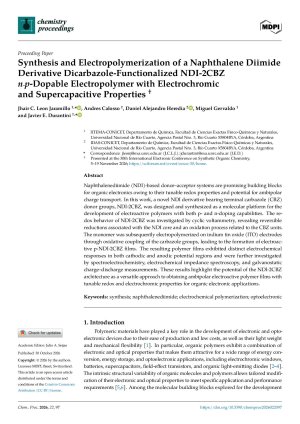
Introduction: Naphthalene diimide (NDI)-based donor–acceptor systems are attractive materials for organic electronics due to their tunable redox properties and potential for ambipolar charge transport. In this work, a new NDI derivative bearing terminal carbazole (CBZ) donor groups, NDI-2CBZ, was designed and synthesized to obtain electroactive polymer films with both p- and n-doping capabilities.
Methods: NDI-2CBZ was synthesized and characterized by electrochemical and spectroelectrochemical techniques. Cyclic voltammetry was used to investigate its redox behavior and to electropolymerize the monomer on indium tin oxide (ITO) electrodes through oxidative coupling of CBZ units. The resulting polymer films were evaluated by spectroelectrochemistry, electrochemical impedance spectroscopy, and galvanostatic charge–discharge measurements.
Results: Cyclic voltammetry revealed multiple reversible redox processes associated with both the carbazole donor units and the NDI acceptor core. Repeated anodic cycling produced homogeneous polymer films on ITO electrodes. Spectroelectrochemical studies demonstrated the reversible formation of dicarbazole radical cations and dications, accompanied by color changes from translucent yellow to green during p-doping. Likewise, reversible formation of NDI radical anions and dianions produced a color change from yellow to red during n-doping. Electrochemical characterization confirmed the ambipolar nature of the polymer and its ability to store charge. Supercapacitor studies showed stable charge–discharge behavior and good capacitance retention.
Conclusions: The synthesized NDI-2CBZ derivative provides an effective platform for the preparation of ambipolar electroactive polymers. These results demonstrate its potential for energy-storage applications and the development of advanced organic electronic devices.
Keywords
Synthesis
Electrochemical Polymerization
n−p Dopable Electrodeposited Polymers
naphthalene diimide
Pseudocapacitors
Electrochromic.
Manuscript
Sciforum-206078.pdf
Extraction of Pectin from Orange Peel Waste and Its Ionic Cross-Linking with Copper and Zinc Ions: Structural Characterization and Antimicrobial Evaluation
Molecular Dynamics Insights into the Recognition of Histone Crotonylation by the AF9 YEATS Domain