Event submissions
Published
This submission belongs to the session S1. Mental Health of the event The 1st International Online Conference on Children's Health
Published date
12 Nov, 2026
Academic Editor
 Valentina Lucia La Rosa
Contribution&Funding
Conceptualization,
[Vasiliki Georgousopoulou] ; [Pantelis Perdikaris] ; [Georgios Manomenidis]
Methodology,
[Vasiliki Georgousopoulou] ; [Georgios Manomenidis]
Software,
[Georgios Manomenidis]
Validation,
[Vasiliki Georgousopoulou] ; [Pantelis Perdikaris] ; [Georgios Manomenidis]
Formal analysis,
[Pantelis Perdikaris] ; [Georgios Manomenidis]
Data curation,
[Pantelis Perdikaris] ; [Maria Amanatidou] ; [Georgios Manomenidis]
Writing - original draft,
[Georgios Manomenidis] ; [Pantelis Perdikaris] ; [Maria Amanatidou] ; [Despoina Koumbagioti] ; [Konstantinos T Petsios] ; [Vasiliki Georgousopoulou]
Writing - review,
[editing] ; [Georgios Manomenidis] ; [Maria Amanatidou] ; [Despoina Koumbagioti] ; [Konstantinos T Petsios] ; [Pantelis Perdikaris] ; [Vasiliki Georgousopoulou]
Supervision,
[Pantelis Perdikaris] ; [Vasiliki Georgousopoulou]
Project administration,
[Georgios Manomenidis] ; [Vasiliki Georgousopoulou]
Funding: --
Citation
Vasiliki Georgousopoulou, Georgios Manomenidis, Maria Amanatidou, Despoina Koumbagioti, Konstantinos T Petsios, Pantelis Perdikaris, Hospitalized Children’s Perceptions of Nursing Care: A Cross-Sectional Study Using Questionnaire Ratings and Coded Drawings, in Proceedings of The 1st International Online Conference on Children's Health, 17 November–19 November 2026, MDPI: Basel, Switzerland
Share
Email
Facebook
Twitter
LinkedIn
Hospitalized Children’s Perceptions of Nursing Care: A Cross-Sectional Study Using Questionnaire Ratings and Coded Drawings

Vasiliki Georgousopoulou 1

Georgios Manomenidis 1
Maria Amanatidou 1
Despoina Koumbagioti 2

Konstantinos T Petsios 3

Pantelis Perdikaris 4
1. Department of Nursing, Democritus University of Thrace, Alexandroupolis, 68100, Greece
2. Department of Nursing, University of West Attica, Athens, 12243, Greece
3. Department of Nursing, National and Kapodistrian University of Athens, Athens, 15784, Greece
4. Department of Nursing, School of Health Sciences, University of Peloponnese, Peloponnese, 22100, Greece
Abstract
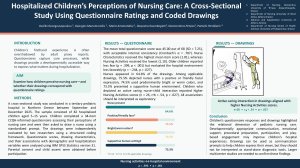
Purpose: To examine hospitalized children’s perceptions of nursing care by integrating questionnaire ratings with coded drawings and exploring correspondence between the data sources.
Design and methods: This cross-sectional study included a convenience sample of 82 children aged 5–15 years hospitalized in a Greek tertiary hospital. Children completed a culturally adapted CCQH-informed questionnaire and a standardized “Please draw a nurse” task. Drawings were coded using a predefined visual-content framework.
Results: The questionnaire total score demonstrated acceptable internal consistency (Cronbach’s α = .79) and a mean of 45.00 (SD = 7.25). Nurses appeared in 64.6% of drawings. Among applicable drawings, 75.5% showed a positive nurse facial expression and 74.5% used predominantly bright or warm nurse-associated colors. Older children reported less fear (ρ = .40, p < .001) but lower Hospital Environment scores (ρ = −.24, p = .027). Parental age was weakly associated with the total score (r = .26, p = .021), whereas most other participant characteristics were not. Among 26 drawings with codable nurse–child interaction, active caring interaction corresponded with higher Nursing Activities scores (U = 33.00, p = .027; rrb = .54).
Conclusions: Children’s responses emphasized nurses’ interpersonal characteristics, whereas responses concerning nursing activities were more variable. Questionnaire and drawing findings jointly highlighted relational and developmentally responsive care, although the exploratory findings require caution.
Practice implications: Pediatric nurses should strengthen age-appropriate communication, procedural preparation, play, emotional support, and participation. Drawings discussed through open-ended questions may complement child-reported experience measures.
Keywords
: child-centered care; children’s drawings; hospitalization; nursing care quality; patient-reported experience; pediatric nursing
Poster
Hospitalized_Children_ePoster.pdf
Maternal psychosocial well-being from pregnancy to five years postpartum and early development in daughters: Evidence from the 'Grandmothers, Mothers, and Their Children’s Health' study
Sleep Disturbance as a Mediator Between Digital Media Exposure and Emotional Dysregulation in Children and Adolescents: A Systematic Review and Meta-analysis