Event submissions
Published
This submission belongs to the session S1. Mental Health of the event The 1st International Online Conference on Children's Health
Published date
12 Nov, 2026
Academic Editor
 Valentina Lucia La Rosa
Citation
Juthatip Nammong, Family Experiences of Caring for Children with ADHD: An Integrative Literature Review, in Proceedings of The 1st International Online Conference on Children's Health, 17 November–19 November 2026, MDPI: Basel, Switzerland
Share
Email
Facebook
Twitter
LinkedIn
Family Experiences of Caring for Children with ADHD: An Integrative Literature Review

Juthatip Nammong 1
1. Doctor of Philosophy Program in Nursing, Faculty of Nursing, Thammasat University, Khlong Luang, Thailand
Abstract
Background:
Attention-deficit/hyperactivity disorder (ADHD) is one of the most common neurodevelopmental disorders in childhood and has substantial impacts not only on affected children but also on their families. Families caring for children with ADHD often experience parenting stress, emotional burden, family conflict, financial hardship, and social stigma. Although numerous studies have examined ADHD-related outcomes, evidence regarding family caregiving experiences remains fragmented, particularly in Asian and Thai contexts.
Objective:
To synthesize current evidence on the experiences of families caring for children with ADHD, with a particular focus on family roles, caregiving challenges, coping strategies, adaptation, and implications for pediatric nursing.
Methods:
An integrative literature review was conducted following the PRISMA guidelines. Five electronic databases (PubMed, Scopus, CINAHL, ScienceDirect, and ThaiJO) were searched for studies published between 2018 and 2024. Twenty-seven studies meeting the inclusion criteria were critically appraised using the Joanna Briggs Institute (JBI) Critical Appraisal Tools. Findings were synthesized using thematic analysis.
Results:
Five major themes emerged: (1) caregivers’ psychological and emotional burden, (2) changes in family functioning and relationships, (3) caregiving adaptation and coping strategies, (4) the importance of social and healthcare support, and (5) cultural influences on family caregiving experiences. Families frequently reported chronic stress, parenting challenges, stigma, and financial difficulties. Positive family functioning, resilience, and supportive healthcare services were identified as key factors facilitating successful adaptation.
Conclusions:
Family experiences of caring for children with ADHD are complex and shaped by multiple psychosocial and cultural factors. Pediatric nurses play a pivotal role in supporting families through family-centered care, caregiver education, emotional support, and collaborative interventions. Future qualitative research should explore family meaning-making and cultural contexts to strengthen pediatric nursing practice and improve outcomes for children with ADHD and their families.
Keywords
Attention-Deficit/Hyperactivity Disorder (ADHD)
Family Experiences
Caregiving
Poster
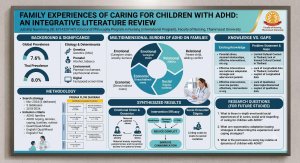
Poster Family Experiences of Caring for Children with ADHD An Integrative Literature Review.pdf
Sleep Disturbance as a Mediator Between Digital Media Exposure and Emotional Dysregulation in Children and Adolescents: A Systematic Review and Meta-analysis
IMPACT OF HOSPITAL CLOWN INTERVENTIONS ON PSYCHOLOGICAL WELL-BEING AND THE HUMANIZED PEDIATRIC CARE: A SYSTEMATIC REVIEW