Event submissions
Published
This submission belongs to the session S1. Mental Health of the event The 1st International Online Conference on Children's Health
Published date
12 Nov, 2026
Academic Editor
 Valentina Lucia La Rosa
Citation
Florencia Talmón Knuser, Laura Lacomba-Trejo, Francisco González Sala, Adverse Childhood Experiences and Psychosocial Adjustment: The Role of Childhood Trauma and Posttraumatic Stress in Adolescents in Residential Care, in Proceedings of The 1st International Online Conference on Children's Health, 17 November–19 November 2026, MDPI: Basel, Switzerland
Share
Email
Facebook
Twitter
LinkedIn
Adverse Childhood Experiences and Psychosocial Adjustment: The Role of Childhood Trauma and Posttraumatic Stress in Adolescents in Residential Care

Florencia Talmón Knuser 1

Laura Lacomba-Trejo 2

Francisco González Sala 2
1. Department of Developmental Psychology and Education, Faculty of Health Science, Catholic University of Uruguay, Montevideo, 11600, Uruguay
2. Department of Developmental and Educational Psychology, Faculty of Psychology and Speech Therapy, University of València, Valencia, 46010, Spain
Abstract
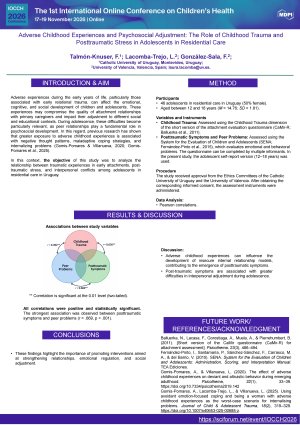
Adverse experiences during the early years of life are linked to early relational trauma, which cause emotional, cognitive, and social impairment in individuals. These experiences affect the quality of the attachment bond between primary caregivers and the child, impacting the child’s subsequent adaptation to the educational setting, especially during adolescence, when relationships with peers become central to their psychosocial development. The objective of this study was to analyze the relationship between traumatic experiences in early attachments, posttraumatic stress, and interpersonal conflicts among adolescents in residential care in Uruguay. Forty-six adolescents participated, 50% of whom were female and ranged in age from 12 to 18 years (M = 14.76; SD = 1.81). Following approval by the Ethics Committee of the Catholic University of Uruguay and the University of Valencia, informed consent forms were signed, and the questionnaires were administered. The variables studied were childhood trauma (CaMir), posttraumatic symptoms, and peer problems (SENA adolescent version). The results show the following: A) A statistically significant positive correlation was found among all variables; B) The strongest association was observed between posttraumatic stress and interpersonal problems, followed by a moderate-to-high correlation between childhood trauma and peer relationship problems. Our results indicate that adverse childhood experiences can influence the development of insecure internal relationship models, contributing to the emergence of posttraumatic symptoms, which are associated with greater difficulties in interpersonal adjustment during adolescence. These findings highlight the importance of promoting interventions aimed at strengthening relationships, emotional regulation, and social adjustment.
Keywords
Adverse childhood experiences
post-traumatic stress
interpersonal conflicts
adolescents
residential care
Poster
Poster FLORENCIA TALMÓN .pdf
Academic Adjustment and Attention-Related Difficulties in Foster Care versus Family-of-Origin Adolescents: The Role of Relational Trauma and Protective Resources
School Environment and Health Risk Behaviours among Adolescents with and without a Migrant Background: Results from the HBSC Study