Event submissions
Published
This submission belongs to the session S1. Mental Health of the event The 1st International Online Conference on Children's Health
Published date
12 Nov, 2026
Academic Editor
 Valentina Lucia La Rosa
Citation
Salvador Alberola, Esther Paulo-Bonafé, Alexandra Elena Sonfelianu, Francisco González-Sala, Adverse childhood experiences: their impact on the mental health of adolescents, in Proceedings of The 1st International Online Conference on Children's Health, 17 November–19 November 2026, MDPI: Basel, Switzerland
Share
Email
Facebook
Twitter
LinkedIn
Adverse childhood experiences: their impact on the mental health of adolescents

Salvador Alberola 1

Esther Paulo-Bonafé 1
Alexandra Elena Sonfelianu 1

Francisco González-Sala 1
1. Department of Developmental and Educational Psychology, Faculty of Psychology and Speech Therapy, University of Valencia, Valencia, 46010, Spain
Abstract
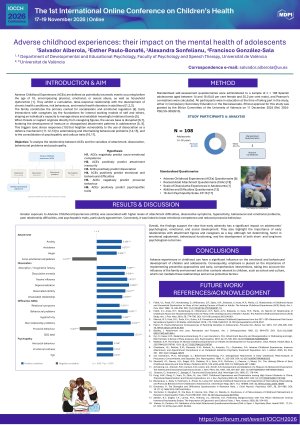
Adverse childhood experiences (ACEs) may constitute a risk factor for the development of secure attachment and healthy psychological adjustment in adolescence. The aim of this study was to analyse the relationship between ACEs and the variables of attachment, dissociation, behavioural problems and psychopathy. To this end, standardised self-assessment questionnaires were administered to a sample of n = 108 adolescents aged between 14 and 18 (64.8 percent female and 35.2 percent male), and Pearson’s correlations were calculated. It was found that greater exposure to ACEs during childhood was positively and significantly associated with: anxiety, avoidance and anger in attachment; with all dimensions of dissociation (in particular, depersonalisation); with increased symptoms of hyperactivity; with behavioural problems; emotional symptoms and difficulties in peer relationships; and psychopathic traits (in particular, egocentrism). Furthermore, a significant negative correlation was observed with the factors of emotional competence and prosocial behaviour. Based on these findings, it was concluded that adverse childhood experiences could have a significant influence on the emotional and behavioural development of children and adolescents. Consequently, emphasis was placed on the importance of implementing preventive approaches and early, comprehensive interventions, taking into account the influence of the family environment and other contexts relevant to children that could act as protective factors.
Keywords
adverse childhood experiences
attachment
mental health
behavioural problems
adolescence
Poster
Poster_Salvador Alberola et al_IOCCH2026.pdf
Beyond Child-Related Risk Factors: Foster Caregiver Competencies and Child Psychological Adjustment Following Foster Care Breakdown
Investigation of the Role of Sociocultural Attitudes Towards Physical Appearance on Psychological Symptoms and Functioning in Adolescents with Anxiety/Depression: Preliminary Findings