Event submissions
Published
This submission belongs to the session S1. Mental Health of the event The 1st International Online Conference on Children's Health
Published date
12 Nov, 2026
Academic Editor
 Valentina Lucia La Rosa
Citation
Berkay Tayşi, Mahmut Cem Tarakçıoğlu, Investigation of the Role of Sociocultural Attitudes Towards Physical Appearance on Psychological Symptoms and Functioning in Adolescents with Anxiety/Depression: Preliminary Findings, in Proceedings of The 1st International Online Conference on Children's Health, 17 November–19 November 2026, MDPI: Basel, Switzerland
Share
Email
Facebook
Twitter
LinkedIn
Investigation of the Role of Sociocultural Attitudes Towards Physical Appearance on Psychological Symptoms and Functioning in Adolescents with Anxiety/Depression: Preliminary Findings

Berkay Tayşi 1

Mahmut Cem Tarakçıoğlu 1
1. Faculty of Medicine, Istanbul University-Cerrahpaşa, İstanbul, 34098, Turkey (Türkiye)
Abstract
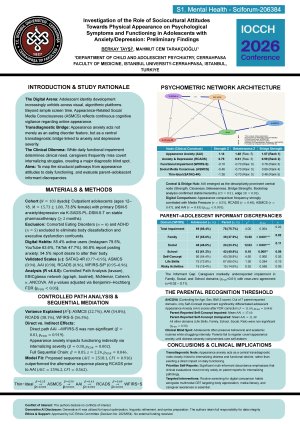
Introduction: This study investigated the relational patterns of sociocultural appearance attitudes, appearance anxiety, and appearance-related social media consciousness on psychological symptoms and daily functioning in adolescents with anxiety and/or depression. It also evaluated parent–adolescent informant discrepancies regarding functional impairment.
Methods: This cross-sectional study included 103 clinical adolescents (aged 12–18, 73.8% female) receiving pharmacotherapy and their parents. Standardized diagnostic interviews (K-SADS-PL-DSM-5-T) and psychometric measures (RCADS, AAI, ASMCS, SATAQ-4R, and WFIRS self/parent forms) were utilized. Data were analyzed using path analysis, EBICglasso network analysis, ANCOVA, and McNemar tests. All p-values were adjusted using the Benjamini–Hochberg FDR method (pFDR).
Results: Path analysis indicated that thin-ideal internalization predicted appearance-related social media consciousness (β = 0.35, pFDR = 0.003), which subsequently predicted appearance anxiety (β = 0.50, pFDR < 0.001). The direct path from appearance anxiety to functioning was non-significant; instead, appearance anxiety exhibited a statistically significant but distinctively weak indirect link with functioning mediated via anxiety/depression severity (β = 0.05, pFDR = 0.046). In the network analysis, appearance anxiety emerged as the descriptively prominent central and bridge node. While adolescents reported higher overall functional impairment (86.4%) than parents (75.7%), this cumulative discrepancy represented only a marginal statistical trend (χ2 = 4.00, pFDR = 0.064). However, domain-specific informant discrepancies remained highly significant within family, school, and social domains (pFDR < 0.01). Finally, parents were more likely to notice their children's anxiety about their appearance when it started to affect their self-esteem (F = 11.04, pFDR = 0.044).
Conclusion: These preliminary findings highlight appearance anxiety as a critical, transdiagnostic node linked to internalizing distress and functional decline. Significant informant discrepancies reveal a critical parental blind spot regarding adolescent internalizing processes, emphasizing the necessity of incorporating structured adolescent self-reports in clinical pediatric decision making.
Keywords
Adolescent
Anxiety
Appearance anxiety
Depression
Functional impairment
Social media.
Poster
Taysi_A0.pdf
Adverse childhood experiences: their impact on the mental health of adolescents
Adult Attachment Dimensions and Child-to-Parent Violence in Spanish Adolescents and Young Adults